Friday, March 30, 2007
Latest Publication
My latest short story "Brutal Rituals" was just published in Space & Time Magazine ! Space & Time published my first two stories, "Birthright" and "Golden Hands."

Tuesday, February 27, 2007
Through the Stargate
A long time ago, when Saturday night actually had shows on that I liked, I watched quite a lot of Stargate. I lost interest after awhile. Probably the show became a saga and sagas usually bore me. But I've started rewatching the show through Netflix. It doesn't have the same enthrallment factor for me as Star Trek or Law & Order or X-Files, but there are some definite pluses.
First, the premise makes slightly more sense than Star Trek. In science-fiction terms, of course. The only aliens are nasty, bad snake things (although more aliens are implied). Everyone else is human. No weird foreheads. No strange ridges. No elongated earlobes. Of course, it is highly doubtful that, absent a universal translator, they would all be able to understand each other. Language evolves, and a bunch of ancient Greeks, ripped away from their original culture, aren't going to speak anything that sounds even like modern Greek, let alone English. But, as E. Nesbit says in The Story of the Amulet, "I think I must have explained to you before how it was that the children were always able to understand the language of any place they might happen to be in, and to be themselves understood. If not, I have no time to explain it now."
Secondly, Stargate is darn good storytelling. There's a rather startling lack of theme. SG-1 goes to a planet. Bad guys are there. SG-1 outwits them. SG-1 goes home. And in the meantime, the audience gets a little bit of mythology and anthropology and lots of statues and stuff. In fact, it is really more fantasy with sci-fi trappings than anything else.
Thirdly, it is a military operation! Thank goodness for a military operation that doesn't pretend to be anything else. Earth is trying to find a way to defeat the bad guys and get allies; there's a notable lack of diplomatic speechifying. And, well, let's face it, fatigues are sexy. Guns are sexy. And those little earpieces that secret agents always wear are super sexy.
Of course, the team breaks protocol about every three seconds. It would be nice to watch a show where the team didn't break a thousand rules in order to go back for that one person or one friend or one artifact, consequently jeopardizing their lives, their mission, Earth and the entire human race. But still, it is nice that there is some structure/heirarchy to the whole operation. (Although I must say that the "President" is a stunningly understanding man who agrees with General Hammond to a truly extraordinary extent.)
Fourthly, they kept the same characters as in the movie. I really admired them for this. There seems to be a (largely American) idea that if you don't have the same actors, you have to create a whole new back story. Timothy Hutton's Nero Wolfe series proves that viewers are fully capable of separating actors from characters and can accept the same actor in different roles or different actors in the same role. It's all fiction. So, I like the fact that in Stargate, Daniel is still Daniel and Jack is still Jack even if they aren't James Spader and Kurt Russell.
Along the same lines, the team is a likable team. This is very, very important to these kinds of shows. I happen to get a huge kick out of Richard Dean Anderson (who I much prefer as Jack rather than MacGyver). He reminds me of Charles Parker from Dorothy Sayer's Peter Wimsey mystery series; they have the same laid-back "ohhh-kay then" kind of attitude. It's a refreshing change from angsty, furrowed-browed heroes (although Jack O'Neill has plenty of furrowing stuff in his past). On top of all that, Andersen is willing to do just about anything. Shortly into the first season, he plays both a caveman and a 90-year-old. In both cases, there's no self-consciousness. You can always tell. Self-conscious actors make the viewer uncomfortable. Andersen doesn't seem to care what the writers throw at him (this was one thing I always liked about Jonathan Frakes).
Plus I like Daniel and Carter. And I really like Teal'c. I think Christopher Judge is a whole bunch of fun as well as a very handsome guy. I admire him for unabashedly acting in Stargate kinds of shows (rather like Kevin Conroy--Batman--who I also really admire; I like it when actors find their range and stick to it).
CATEGORY: TV
Wednesday, February 21, 2007
Lady in the Water Review
First, I should mention that Shyamalan is a virtuoso of atmosphere. It is not simply that one or two or three scenes in his films have atmosphere but that each film leaves one with a definite impression--of fear, apprehension, loneliness. The result is that his films feel whole; they hang together. It is a nice change from the "then this happens, then this happens" feeling of so many movies and books (although Shymalan comes pretty close to that approach in Lady). He also has a tremendous ability to command strong and unusual performances from a range of actors.
I came to the movie with zero expectations. This was a good thing. If I had watched the movie expecting, well, the movie that was previewed, I would have been sorely disappointing. There are so many great mermaid myths out there, why not utilize them? But the movie isn't really about mermaids or merpeople or merlore. About a half hour into the film, I decided that Shyamalan is really talking about writing. Or rather, the process of writing. Or, to be specific, Shyamalan's process of writing.
How does one create a story? How does one determine the purpose of the characters, their influence on each other and on the plot? Naturally, the film arrives at the conclusion so often used by Shyamalan himself: the purpose of the characters can never be determined until the very end, where it will reveal itself in unexpected ways. Personally, I think Shyamalan overuses this approach, but I found the process by which he arrives at that particular writing choice to be fascinating. His tendency to use "trick" endings is built into his understanding of story itself. (And it is no mistake that Story's name is "story.")
Considering Shyamalan's proclivity for unexpected endings, I was touched that he saved for himself the role of the writer. Wrapped up in this role is, of course, the wish of every writer that his or her work will be profound, remembered, influential. But Shyamalan (who is, by the way, eminently photographable) saves the role from too much back-patting with the writer's final question to Story. With stammering incoherence, the writer acknowledges the improbability that words alone change the world; he knows how fragile or ill-remembered words can be. Language only becomes a risk when the writer risks himself.
And that willingness to risk is applauded over the critic's pithy deconstructions (however hilarious). Although I did wonder if Shyamalan was indulging himself a bit there. Well, it's his film; he can do what he likes.
At the risk of being eaten, I will indulge in some of my own criticisms. Like all of Shyamalan's work, I am not sure how much I see in his work compared to how much Shyamlan intended. Granted, work with substance is preferable to work without substance. But in order to move Shyamalan from good filmmaker to classic filmmaker, I think he needs more purpose: a sense of direction. Like The Village, Lady in the Water seems to have so many great ideas without focus. The ideas are engaging; Shyamalan has a lot to say. But the form or structure behind the "lots of something to say" is missing.
Still, I recommend Lady in the Water; I advise only no expectations.
CATEGORY: MOVIES
Monday, January 29, 2007
Another Jane Eyre--Hooray!
I'm a big Jane Eyre fan. I like 19th century novels, and I like happy endings (which many 19th century novels don't have), so Jane Eyre gives me all I want.
The latest Jane Eyre series is another British production, starring Toby Stephens (as Rochester) and Ruth Wilson (as Jane). The casting is odd but effective. As with Timothy Dalton, the classical description of Mr. Rochester is sacrificed for the sake of very, very good acting.
 This means that we ignore the fact that Toby Stephens is a very handsome guy as well as an extremely youthful one. The ages aren't too far off (Stephens is currently 37; Ruth Wilson is 25), but it is hard to remember this, just as I can never believe that Zelah Clarke and Timothy Dalton (from the 1983 Jane Eyre series) are twenty years apart (they aren't; they're ten years apart). Like many casting choices, Jane and Rochester are a problematic pair--neither are roles you want to sacrifice to novices, no matter how appropriate in appearance.
However, as a relative novice, Ruth Wilson does a splendid job, and I place her up there with Zelah Clarke. In fact, in some ways, I think she captures Jane's youthful fascination with Rochester better than Clarke.
 The 2006 series does a number of other things right, including the selection of material and the use of flashbacks. First, it is carefully, and faithfully, cut to a specific theme. This is the only way to handle those huge 19th century novels where a billion different ideas are presented at once (the plot of Jane Eyre is deceptively straightforward; there's a lot of meat on them bones). The series writers chose a rather modern theme--the search for affection by a young woman starved of any true affection for most of her life--and yet one in keeping with the book. Too often, historical scriptwriters choose modern themes that do not in any way resonant with their non-modern material. Jane Eyre being what it is, and Bronte being what she was, this particular modern theme in no way jars with the material or the setting.
My personal feeling is that the main theme of Jane Eyre is more closely achieved by the 1983 version; it is a theme echoed in Richardson and Austen (however much Bronte would have disliked the comparison): integrity means relying on and being faithful to one's own judgment. Jane doesn't run from Rochester because she's a prude; she runs from Rochester because she will not sacrifice her judgment even to her own desires. This is a pretty powerful concept and always modern.
Having said that, I don't mind other approaches so long as those approaches play fair, which the 2006 series does. The modernness of the theme does not detract from the basic non-modernness of Jane Eyre. She is not a 21st century girl, no matter how much her struggles touch her 21st century audience. For example, one of the movie (not television) Jane Eyres has Jane and Helen acting like a couple of wise-cracking junior high students. It makes me wince every time I watch it. (And yes, I do watch it even though it makes me wince.)
To be fair, the Jane and Helen section (Lowood School) is difficult to cast and to script. I was impressed by the use of flashbacks in the 2006 series, and I thought the writers should have used more of them--that is, skip the childhood/Lowood scenes and start with Jane's arrival at Thornfield. However, the childhood/Lowood scenes are necessary; we learn about Jane's passionate nature (later tightly controlled), her treatment by the Reeds (foretelling later contact with the family), her friendship with Helen, her training at Lowood School--all important scenes which help explain Jane's character and motivations. It's just they are so very tedious. I've honestly never seen a presentation of Jane's childhood that didn't either bore me or make me laugh it was so unlikely. The 2006 series has the merit, at least, of being quick.
More on the childhood/Lowood section: one huge problem is that we 21st century Americans have a hard time understanding why a respectable and independent headmistress, Miss Temple, would kowtow to someone like Brocklehurst, so most versions eliminate the headmistress completely, giving the whole school section a rather lopsided, episodic feel. Unfortunately, if she is left in, the section runs the risk of being turned into a dissertation on feminism, which really isn't its point. The Lowood section, like the final section, is more about religion than anything else.
 In regards to the final section, with St. John Rivers & company, the 2006 series (thankfully) leaves it in. A great many of the themes in Jane Eyre come to a head in the final section. The casting of St. John (pronounced "Sijin," which for some reason strikes me as so elegant; I never tire of hearing it) is fascinating, partly because the choice once again reflects theme. The 1983 series cast the exceedingly tall, exceedingly blond and exceedingly stern Andrew Bicknell while the 2006 series cast the dark, short, tightly wound Andrew Buchan. Both versions work. The 1983 series emphasizes St. John's domination of Jane; the 2006 series emphasizes St. John's repressed nature (and yes, that is "repressed" in the Freudian sense). Since both domination and repression are factors in St. John's personality, both interpretations work.
All in all, the 2006 series is worth viewing--more than once, if you're me. I like the ending best of all the versions, including the 1983 version. It doesn't leave you quite as bereft (happy ending, okay, now everybody go home), and you get to see the kind of woman Jane Eyre becomes, surrounded by family, friends, and a great deal of affection.
The latest Jane Eyre series is another British production, starring Toby Stephens (as Rochester) and Ruth Wilson (as Jane). The casting is odd but effective. As with Timothy Dalton, the classical description of Mr. Rochester is sacrificed for the sake of very, very good acting.
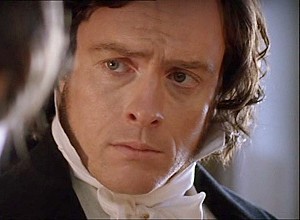 This means that we ignore the fact that Toby Stephens is a very handsome guy as well as an extremely youthful one. The ages aren't too far off (Stephens is currently 37; Ruth Wilson is 25), but it is hard to remember this, just as I can never believe that Zelah Clarke and Timothy Dalton (from the 1983 Jane Eyre series) are twenty years apart (they aren't; they're ten years apart). Like many casting choices, Jane and Rochester are a problematic pair--neither are roles you want to sacrifice to novices, no matter how appropriate in appearance.
However, as a relative novice, Ruth Wilson does a splendid job, and I place her up there with Zelah Clarke. In fact, in some ways, I think she captures Jane's youthful fascination with Rochester better than Clarke.
My personal feeling is that the main theme of Jane Eyre is more closely achieved by the 1983 version; it is a theme echoed in Richardson and Austen (however much Bronte would have disliked the comparison): integrity means relying on and being faithful to one's own judgment. Jane doesn't run from Rochester because she's a prude; she runs from Rochester because she will not sacrifice her judgment even to her own desires. This is a pretty powerful concept and always modern.
Having said that, I don't mind other approaches so long as those approaches play fair, which the 2006 series does. The modernness of the theme does not detract from the basic non-modernness of Jane Eyre. She is not a 21st century girl, no matter how much her struggles touch her 21st century audience. For example, one of the movie (not television) Jane Eyres has Jane and Helen acting like a couple of wise-cracking junior high students. It makes me wince every time I watch it. (And yes, I do watch it even though it makes me wince.)
To be fair, the Jane and Helen section (Lowood School) is difficult to cast and to script. I was impressed by the use of flashbacks in the 2006 series, and I thought the writers should have used more of them--that is, skip the childhood/Lowood scenes and start with Jane's arrival at Thornfield. However, the childhood/Lowood scenes are necessary; we learn about Jane's passionate nature (later tightly controlled), her treatment by the Reeds (foretelling later contact with the family), her friendship with Helen, her training at Lowood School--all important scenes which help explain Jane's character and motivations. It's just they are so very tedious. I've honestly never seen a presentation of Jane's childhood that didn't either bore me or make me laugh it was so unlikely. The 2006 series has the merit, at least, of being quick.
More on the childhood/Lowood section: one huge problem is that we 21st century Americans have a hard time understanding why a respectable and independent headmistress, Miss Temple, would kowtow to someone like Brocklehurst, so most versions eliminate the headmistress completely, giving the whole school section a rather lopsided, episodic feel. Unfortunately, if she is left in, the section runs the risk of being turned into a dissertation on feminism, which really isn't its point. The Lowood section, like the final section, is more about religion than anything else.
 In regards to the final section, with St. John Rivers & company, the 2006 series (thankfully) leaves it in. A great many of the themes in Jane Eyre come to a head in the final section. The casting of St. John (pronounced "Sijin," which for some reason strikes me as so elegant; I never tire of hearing it) is fascinating, partly because the choice once again reflects theme. The 1983 series cast the exceedingly tall, exceedingly blond and exceedingly stern Andrew Bicknell while the 2006 series cast the dark, short, tightly wound Andrew Buchan. Both versions work. The 1983 series emphasizes St. John's domination of Jane; the 2006 series emphasizes St. John's repressed nature (and yes, that is "repressed" in the Freudian sense). Since both domination and repression are factors in St. John's personality, both interpretations work.
All in all, the 2006 series is worth viewing--more than once, if you're me. I like the ending best of all the versions, including the 1983 version. It doesn't leave you quite as bereft (happy ending, okay, now everybody go home), and you get to see the kind of woman Jane Eyre becomes, surrounded by family, friends, and a great deal of affection.
Thursday, January 11, 2007
Forensics: Truth & Fiction?
I enjoy forensic shows, so recently I picked up a book in which the author, Connie Fletcher, interviews crime scene investigators, forensic specialists, homicide detectives. The interviews themselves are very interesting, ranging from advice to stories (true to form, I prefer the stories), but the introduction by the author very nearly put me off the entire book.
To summarize, the introduction basically says, "All that stuff on CSI shows, well, it looks clever, but it isn't REALLY the way things happen. And I went out and interviewed REAL forensic scientists, and here's the REAL scoop."
I don't get this attitude at all. I've run into it before--people who think that all fiction is basically deceitful, and therefore in need of being unmasked, showed up. Well, yes, fiction is deceitful--that's why it's fiction. I wouldn't watch forensic shows if the tests took the ordinary amount of time they do in real life. I wouldn't watch them if there wasn't some kind of consistent storyline either. I quite enjoy the occasional CSI:LV that gives you four cases in one episode (the one with the bodies conversing in the morgue is classic). But in general, I don't expect the kind of reality that, well, you find in reality. It's drama! It isn't supposed to be real.
Which doesn't mean that fiction shouldn't have a patina of reality. The ability to get the reader/viewer to (really) believe in the fictional world is part of the artist's goal. The enormous irony is how much this worries the spit out of humanities majors (the author describes herself as "English major-y"). Oh, my goodness, all those viewers out there who are being hoodwinked by shows that make forensics look more glamorous or more grim or more superficial (I couldn't figure out exactly what the author's beef was) than it really is. It's as if our colleges and universities are producing an entire generation of humanities graduates who are about as left-brained/anti-fiction oriented as anyone since Plato got into a fuss about the influence of plays on the young.
Newsflash, people--fiction is supposed to lie, enchant, bamboozle, astonish. One of my favorite movies is Galaxy Quest; one of my favorite scenes is when the Tim Allen character has to explain to the alien commander that his show (a take-off of Star Trek) is a lie ("Explain it to him in words a child could understand."); yet, at the end of the movie, Galaxy Quest (the television show) has been revived. The dangers of fiction are weighed against its joys and found less important, not because the dangers don't exist but because a world without fiction is, let's face it, dull. It is a world run not by accountants, which I wouldn't mind so much, but by well-meaning products of higher education. And, speaking as one, that I do mind. (Woe to that generation that replaces our superficial, grim, and sometimes downright stupid television programming with high-minded dramas addressing issues of class, race, and gender alongside accompanying disclosures of said dramas' underlying ideologies as well as their purposes and applications--a curse upon your heads!)
In any case, as I've been reading through the book's interviews, I've been amused by, yep, I'll say it, how accurate the shows actually are. I had figured that most of what I saw on television was hyperbole. I didn't realize how much detecting forensic specialists do. To be honest, I kind of figured the shows greatly expanded a minor role in crime investigation to create the CSIs we know and love. But no, CSIs as separate entities within the investigation heirarchy do in fact exist and do descend upon the scene after the cops go in. They even occasionally interview suspects (rather than leaving all interviews up to the cops--that truly surprised me). A couple of the stories read like episodes (and may have been the original inspirations; television writers are notorious borrowers). There truly are a huge number of specialists. You truly can squirt stuff that illuminates blood stains. Many of the stories are way stranger than anything that shows up on television (nobody would believe them). Some of the specialists are as seriously off-kilter as Greg or Grissom or Bones. Cases have been clinched with evidence as minor as a scrap of cloth or teeth found in a fire. All in all, I've been impressed--the patina of truthfulness on CSI shows is more than a patina; it is actually based on legitimate research.
But again, in terms of fiction, what matters is the patina, not the research. Do the viewers believe? Does the story work? Do the characters live for us? Do we care about them? Are we carried away by the work? Are we satisfied? That is what matters. Which isn't to say that people are always satisfied by fictional pieces. But the problem lies in the realm of artistry, creativity, not to mention plotting, NOT in the differences between reality and the "lie." Leave that sort of "I'm SO appalled" attitude to the politicians. Leave the fun of the thing to the rest of us.
Wednesday, January 10, 2007
Monday, January 1, 2007
Superman Simplistic
I recently read Red Son, the graphic novel re-imagining Superman as a Soviet hero.
It's an interesting idea. The basis for the concept is that Superman is the all-American-spinach-eating-protect-the-flag hero, but suppose instead of dropping down into Kansas, his pod had landed in the Ukraine during the age of the Soviet Empire?
There are a few snags right from the beginning, the most basic being the implausibility that farmers in the Ukraine were any more devoted to Lenin's principles than Kansas farmers in 1938 were to FDR's New Deal (the latter being slightly more plausible than the former). It also implies a huge amount of environmental determinism. However, I'm willing to allow for the basic assumption of the concept--that the all-American boy could become the all-Soviet boy.
Unfortunately, how that concept is worked out is not at all plausible. At the heart of the Superman story is the problem of power. Superman can do just about anything he wants to. He can rescue people before they want to be rescued. He can enforce government policies or undermine government decisions. He's a god. How does a god handle that power? Does he allow for human agency? Does he allow badness to continue if it can't be stopped by legal means? Some really interesting questions, which Frank Miller, in his Batman series, deals with at length.
The essence of the American Superman is that he doesn't act outside of the law--any more than a vigilante must, that is. He allows a tremendous degree of latitude amongst his enemies. He restrains his power. The proposal in Red Son is that Superman will choose the alternative--to help people against their will, help them for their own good. Mormons would call this Lucifer's plan: that all of us will be saved, willy-nilly, whether we choose it or not.
Again, interesting idea, but in order to make an idea like this work, you have to know something about power and the problems of power and the problems of restraint. And I'm not entirely convinced that the folks who wrote Red Son do.
The first problem is that smartness and ability do not automatically translate into success. Soviet Superman decides that he must take over the Soviet Union because only he can prevent hunger and suffering. Well, okay, but those are pretty difficult problems to solve without causing catastrophic financial and social side-effects. The Soviet Union bankrupted itself trying to solve similar problems, with a great deal more personal interference in people's lives than FDR's New Deal. Yet, Superman effortlessly solves them.
The problem here is that human institutions, run by a god or not, are still human institutions. This is actually a problem that shows up a lot on Superman shows. In the delightful show Lois & Clark, the writers often had Clark use his superspeed to hunt up data on the Internet. As those of us with dial-up can attest, the Internet can only work as fast as its connection. Just because you may find things quickly, doesn't mean you can. Just because you have super abilities, doesn't mean super solutions will result, no matter how many people you mind-meld with. (To mix my cultural icons.) Just because you want to feed people doesn't mean you won't have to get the food from somewhere. Where do you get it from? Well, how about another country? But then you've just demolished the exportable goods of entire nation. So much for their economic infrastructure--what are you going to do about it? All this would take a little bit more than an occasional mind-fixin' on Superman's part to smooth out and a lot longer than sixty odd years. (It is possible that the writers are saying that Superman perceives the problems as fixed, not that they are actually fixed. However, I get the impression that the writers are saying that even if Superman could fix such problems, the loss of agency wouldn't be worth it.)
Of course, the most devastating side-effect of Superman's presidency is the destruction of freedom/personal agency, something the writers of Red Son address at length. The problem here is that it is a rather obvious side-effect. If Superman is as smart and as good at government planning as the writers attest, loss of liberty would be pretty obvious pretty fast. It would not take Superman several decades to figure out.
Once he figured it out, he might or might not make concessions to the issue--rather the way die-hard Maoists in China sort of make concessions to Hong Kong. (Why turn down a money-maker on your downstep?) But he would have to grapple with it. I find this a far more interesting dilemma than the sudden shocking realization that oh, my gosh, using absolute power annoys people. I'm thinking here of Orson Scott Card's Worthing Chronicle where a goddess is faced with a similar decision. When she decides to interfere for the sake of compassion, her father-figure is pleased, even though he disagrees. After all, how can a good person just stand by and let awful things happen? When Picard does this in Star Trek: Next Generation for the sake of the Prime Directive, you want to march into the television and punch him. (Especially since he is never consistent.)
Yet, as the writers of Red Son point out, life in a bottle--no matter how clean and safe--isn't worth much. Which is to say that the writers have a point, it's just a rather obvious one and not one that Superman could really avoid for more than, say, three seconds. Or would avoid. Issues of control usually come down to the possibilities of benefit,and every society has this issue. At its most basic level, we allow the government to put up road signs, detour traffic, and enforce driving laws for the sake of better roads and safer travel. A Superman who was far enough gone to give insurgents new personalities would not be overcome by remorse at the thought; he would be wholly convinced of the necessity. When Nixon and Krushchev had the Kitchen Debates, it was not "Control is bad" versus "Control is good." Rather, it was "Look how freedom produces such a wide range of choices" versus "Ah, you crass Americans with your love of materialism. We aren't so shallow." (And if you don't think people are still having this argument, you haven't been in higher academe lately.)
In other words, it would have been much more interesting if, during Red Son's Batman-Superman confrontation, they had debated the merits of their separate ideologies; except Frank Miller already did that in The Dark Knight Returns.
To be fair, many of the elements concerning power and its side-effects are in Red Son; they just seem too tidily disposed of, resulting in a resolution that is unbelievable (within the confines of the novel), although clever.
I do like Batman in a big Russian hat.
Subscribe to:
Posts (Atom)