As stated in my previous post, I will be comparing a Sliders episode to a Stargate episode:
Sliders: "Prince of Wails"--the gang shows up on a world where the British won the Revolutionary War, and the Sheriff of San Francisco is trying to overtake the throne (think Robin Hood). The gang stops him, helped by American Revolutionaries and a repentant prince.
Stargate: "Beneath the Surface"--the gang is trapped in a world where they have been brainwashed to believe they are part of a society recovering from an extreme Ice Age when actually they are slave-workers.
(a) The Slider world entails a greater suspension of disbelief .
From the descriptions above, this doesn't seem likely. But it is. Even if the Brits won the Revolutionary War, British society was already moving towards a constitutional democracy in the 18th century. A British America would be more like, well, Canada, than some medieval throw-back.
Now, I will grant that the "underground workers" motif is also rather overdone and slightly ridiculous. Where the Stargate writers come out ahead of the Sliders writers here is that they give their bad guy reasons that are entirely sensible within the bad guy's narrow worldview. He doesn't want to create problems with Earth; he also doesn't want to change his society's structure. After all, what would his society do with all those workers if they were let out?
(b) The gang convinces the terrorist rebels in Sliders to follow Quinn.
How many terrorist organizations do you know simply accept a new bunch of people with no prior credentials or previous terrorist behavior and put them in charge?
Yes, the answer is zero.
Any closed, paranoid system is riddled with rivalries, inside politics, and ladder-climbing. New people--including in the U.S. Senate--rarely walk in and just start running things.
In Stargate, SG-1 are the rebels. They don't convince anyone to follow them; they just convince each other.
(c) The rebellion in Sliders is enthused by Quinn's idealism: rob the rich to give to the poor.
In Stargate, on the other hand, the other workers don't want to rebel, and they treat SG-1 like undependable mavericks. When the SG-1 members do rebel, they don't rebel in terrorist ways. Their goal, for most of the episode, is to keep the underground society working: survival is more important than idealism.
SG-1's dissatisfaction with the system begins when brainwashed Samantha Carter suggests to the higher-ups a way to make the equipment run more efficiently. After she is turned down for, unbeknownst to her, political reasons on the surface, she becomes suspicious. Her suspicions fuel the other SG-1 members' questions and their eventual rebellion.
In other words, if this really was an underground society recovering from an extreme Ice Age, SG-1 would eventually take over anyway, just because they are the most competent people in the society.
(d) All tension in the Sliders episode is due to the team needing to save the rebels before they slide. It is entirely external.
In contrast, the Stargate tension is caused by the behavior/interactions of SG-1.
If the SG-1 members just accepted their brainwashing and went on working, there would be no main plot. There is a respectable subplot in which General Hammond becomes more and more suspicious about the disappearance of his team, and, perhaps, eventually, SG-1 would have been found. But the actual episode is less about the imposition of an external problem (evil bad guys) and more about the team members dealing with an internal problem (who are we? why is this society so badly run? are we actually meant for something better?).
In other words, the friendship of SG-1 is the main material of the episode, not rallying the troops to fight back! Working through the problem matters more than confronting the bad guy who isn't confronted until the very end in an extremely short scene.
To summarize, in general, Stargate episodes are more about the problem and less about the chase. And that I like.
Here are some not bad Sliders episodes--although the concepts behind some of these are extremely silly, the episodes focus on the problem (mostly), not the chase:
"Eggheads" (1.6)
"The Weaker Sex" (1.7)
"The King is Back" (1.8)
"Luck of the Draw" (1.9)
"Love Gods" (2.2)
You may note the episodes are all from Seasons 1 and 2 when John Rhys-Davies was still a powerhouse on the show. He is one of the most excellent aspects of Sliders!
Showing posts with label Star Trek. Show all posts
Showing posts with label Star Trek. Show all posts
Thursday, January 12, 2012

Tuesday, January 10, 2012
Sliders v. Stargate: Why Stargate is Better, Part 1
I recently started watching Sliders again after many years. As with Stargate, I enjoyed Sliders when it first came out, stopped watching (probably because I lost access to a television), forgot about it, then resumed watching over a decade later.
The difference: I'm now a Stargate fan; I re-lost interest in Sliders after a dozen episodes.
On paper, this shouldn't be so. Both shows involve single-stories for most of their initial season episodes (I prefer single stories to ongoing arcs). Both shows have a fairly enjoyable scooby gang. Both shows' devices deliver both fantasy and science-fiction plots.
However, there are differences, and ultimately, those differences account for my lack of interest in Sliders.
The listed differences below all refer to Sliders:
(1) The overuse of the "save civilization through revolt" premise.
Every other, if not every, Sliders episode goes something like this: the gang shows up in a world that is corrupt in some way; the gang finds the underlying rebel group, supports it, and somehow leads it to victory.
Now, to be fair, Stargate includes a fair share of these episodes although, in general, the Stargate writers are rather better at implying things aren't that easily fixed; bad guys just don't fold; they do need to be blown up.
Still, SG-1 does spend a tremendous amount of time encouraging people to revolt against the Goa'uld.
The major difference: a Stargate episode concentrates on the discovery of the problem rather than on the revolt. Idealistic people being lead to revolt is, frankly, rather boring. Les Miserables' plot of Jean Valjean and Javert is two billion times more interesting than the leader of the students being stupid and getting everyone shot. (What makes the American Revolution so interesting, in my mind, is how surprisingly hard-headed and pragmatic the "rebels" were. The French Revolution, on the other hand, just makes me tired: idealism, corrupt idealism, more corrupt idealism . . . Napoleon. Okay, can it stop now?)
(2) Wade being in love with Quinn.
Within about two episodes of Sliders, it becomes clear that the writers didn't really think through the whole Wade-Quinn equation. They actually wanted Quinn to be a kind of love-them-and-leave-them type, and having Wade along for the ride--the girl Quinn continually rejects by pursuing other women--makes Wade look somewhat pathetic and Quinn rather confused (since he is also supposed to also be harboring affection for Wade).
In reality, if Quinn were not a Lothario, he would hook up with Wade simply because there isn't anybody else comparably steady on his horizon. The fact that he doesn't . . . makes no sense.
In comparison, Stargate Samantha Carter's affection for Jack--while steadily maintained through several seasons--never gets in the way of her having a life (I consider Carter one of the most together female characters on all of television; yeah, she even beats out Scully and Bones). Also, the reason for the non-consummated relationship make sense: military rules and, frankly, Jack's incredible detachment. Carter may hold a torch for him, but she isn't an idiot. And she's got plenty of other things to do.
(3) Possibly the biggest problem with Sliders is the underlying plot device of the slide. Every episode is a "got to solve the problem before . . ." plot: every, single one.
The irony here is that the writers treated the device of location as a deficiency--when it really wasn't--but not the timing device. In Season 3, the writers changed the underlying location rules to include all of California, not just San Francisco; this actually took away some of the show's coolness--the ways in which a single city can be altered by historical events. Without this ongoing issue, the episodes could be set anywhere: different planets, the past, the future, Mars, someone's mind. The idea of parallelism became a non-issue.
Meanwhile, the "have to slide in X hours" device continued to plague the show. Every episode is about corralling the characters, so they can leap. EVERY EPISODE. This results in lots and lots of running around, lots and lots of chase scenes, lots and lots of rescuing people at the last minute . . .
One or two episodes of this type is fine. Stargate (and Star Trek: TNG) did their own share of "got to get away before the sun/planet/starship explodes" plots--just not every single episode. AND both Stargate and Star Trek: TNG used different solutions to get away. With Sliders, sliding is the solution--every time.
(4) The premise of searching for home is weak.
Yes, I know, this is Star Trek: Voyager's premise, but Star Trek: Voyager's premise makes sense because (a) it is actually possible within the confines of the show--since in Star Trek, space operates in a straight line, if the ship just keeps moving in one direction, it will eventually get home; (2) it is actually possible to shorten the trip; (3) the characters are already under the control of a benevolent dictator--that is, they are already part of an organization controlled by a single authority (Captain Janeway), so her insistence that she knows what is best for them makes sense psychologically.
But the first two seasons of Sliders continually underscore the idea that getting home is practically impossible, and the Earths that the characters encounter are increasingly out of sync with their original reality. Why not just stay somewhere? Why continue to follow Quinn who has no authority over the others?
I understand that at the end of Season 3, the Sliders writers inserted a new premise for leaping: the pursuit of the bad guy. However, this makes the show a serial, which I don't care for. (I endure The Mentalist by ignoring the Red John episodes as non-canon.)
Stargate, on the other hand, has the premise of protecting the planet the characters happen to live on plus the premise of FUN. When Daniel gets all archaeological and Jack starts talking about blowing things up, fun is what they are talking about: let's go explore places because it is a HOOT!
As my reviews of Stargate indicate, the show does become more and more serial after Season 4, and I have less interest in the later seasons. Still, the serial nature of SAVE THE EARTH makes substantially more sense than PURSUE THE BAD GUY. The latter becomes wearisome since not catching the bad guy is boring and almost catching the bad guy but continually just missing is aggravating and manipulative. The Earth, on the other hand, can be saved over and over and over.
In Part II, I will compare a Sliders episode to a Stargate episode.
Friday, November 13, 2009
Another Lawsuit for Star Trek
Case 3: "Suddenly Human" (ST:NG, Season 4) in which a young human man, Jeremy Rosso, is discovered on an alien (Talarian) ship. In a Light in the Forest twist, the crew learns that Jeremy, or Jono, was "adopted" by his captors between 5-7 years old and has fully assimilated to his adoptive culture. Despite the existence of Jeremy's human grandmother, Admiral Rosso, Picard ultimately decides to return the young man to his adoptive parent.
Plaintiff: Admiral Rosso
Defendants: Captain Picard, Starfleet
Argument: Admiral Rosso is appalled that her grandson, and only living relative, would be returned to the people who attacked a Starfleet outpost, resulting in the deaths of her son and his wife. She believes the Enterprise should have returned Jeremy to human space as soon as he was discovered. She allows that the political situation was tense but argues that the Enterprise could have easily outmaneuvered and outrun the Talarian ship.
Decision by Judge Kate: No damages against Starfleet. Captain Picard's actions, however, will be submitted to a review by Starfleet. Although the decision to return Jeremy to his Talarian father was likely the correct one, Captain Picard did not allow for an adequate examination of Jeremy Rosso's mental state or his Talarian home life. Captain Picard is, after all, a diplomat and has gotten himself out of stickier situations!
Pending Starfleet's decision, Admiral Rosso will not be awarded damages. This will not, of course, prevent Admiral Rosso from making Captain Picard's career a very uncomfortable one (like maybe the Enterprise finds itself sent to the most distant outposts for the next year).
Tuesday, June 16, 2009
Suing Star Trek
I am a huge Star Trek fan. I am also a big fan of Phil Farrand's Nitpicker's Guides (sadly, he doesn't write them any more). With the Nitpicker's Guides in mind, I have started this series of posts: Suing Star Trek.
Every now and again, whilst watching a Star Trek episode, I think, "You know, if Star Trek didn't belong to such a happy go lucky future, the families of Star Trek personnel would be suing the Federation blind."
For example, take "Genesis" (ST:NG, Season 7) in which the intrepid crew "de-evolves" into various primitive life forms: a spider, a caveman, a Klingon beasty thing, a fish, etc. It is actually quite a fun episode! Data saves the day, of course (since he can't de-evolve into anything but a pile of circuits). Phil Farrand and his nitpickers cover the basic scientific improbabilities (as in the basic scientific ridiculousness) in Farrand's second NG guide: suffice it to say, that the "de-evolutions" are caused by a virus that is caused by the activation of a dormant T-cell which is caused by Crusher giving Barclay a shot.
Malpractice anyone? That's a pretty straightforward line of causation! Not difficult for a lawyer to prove at all, especially since Crusher admits it.
Who would bring the lawsuit? The parents of the poor crewman who is ripped to shreds by some beasty thing (Picard and Data find him dead on the bridge).
I would award the parents considerable damages: the medical procedures on the Enterprise are appallingly lax. I'm not a doctor, so I would let the Federation medical council decide whether Crusher should lose her license for producing a massively dangerous virus, no matter how inadvertedly. (One of the annoying but also rather sweet aspects of Star Trek is how readily and quickly all is forgiven!)
Case 2: "Phantasms" (ST:NG, Season 7) in which Data, whilst dreaming, stabs--but does not kill--Troi. Data's dreaming program was activated a season earlier when Dr. Julian Bashir turned on a device in Engineering. Data has continued to dream regularly. In "Phantasms," Data experiences waking dreams brought on by inter-phasic bugs; the bugs were brought on board with the new warp core. He stabs Troi while in a waking dream.
Plaintiff: Troi's Mom
Defendants: Data*, Julian Bashir, the Enterprise, and the Federation
*In accordance with the legal decision made in ST:NG, Season 2, "The Measure of a Man," Data is considered fully sentient; he can be sued.
Argument: Dr. Bashir's activation of the device was unauthorized; he was aboard the Enterprise, fiddling with the device, without clearance. After the dream program was activated, Data continued to use it with the full knowledge of the captain and crew despite inherent risks: nobody really knows what Data does when he dreams. Also, Data's current "waking dream" state is caused by an infestation of bugs which should have been irradicated before the installation of the warp core. Troi's mother wants damages awarded to Troi for pain and suffering; she wants damages awarded to herself for emotional (vicarious) pain and suffering.
Decision by Judge Kate: No damages against Dr. Bashir, Data, or the Enterprise: Data has experienced dreams for over a year without harmful results. He is no more or less likely to experience "waking dreams" than a flesh and blood humanoid. Hallucinating crewmembers is a risk attendant upon service in Starfleet, especially for the ship's counselor (Troi).
Minor damages against the Federation: check the friggin' warp core for bugs, people! I mean, really!! Since inter-phasic technology was used to create the new warp core, the possibility of infestation was foreseeable and therefore, preventable.
No damages awarded to Troi's mother but a reprimand in the file that Troi's mother not interrupt or otherwise disrespect counsel. Her daughter is an adult and has chosen a risky lifestyle which includes being stabbed by sleep-walking androids, turning into a fish, and being surgically altered to appear as a Romulan. Get over it.
Wednesday, June 3, 2009
Star Trek: Yes, the Most Recent Movie
So . . . I saw it. Not at the local IMAX unfortunately, and it is a movie worth seeing on a very large screen. The visual effects are AWESOME. There's no other word for it--AWESOME. Finally, the Enterprise has the kind of maneuverability you see with Battlestar Galactica planes. It took long enough. Pretty stellar stuff.
Before I continue with what I liked and didn't like, I have to state I don't think Classic Trek complainers have a leg to stand on. The movie makes clear from the first scene (part of which I missed because I was late to the theater) that this is an alternate timeline--I mean, if I picked up on this standing in the aisle, waiting for my eyes to adjust whilst holding popcorn, I should think most audience members would be able to as well.
Now for what I liked (and the reason I will rent the movie multiple times when it comes out on DVD): the interactions of our favorite Classic Trek characters. Reality-wise, it is unlikely that all these people would be assigned to the same ship first go out of Star Fleet Academy. However, it's a good excuse to watch the characters together. I spent most of the movie chuckling to myself--not just over things like, "I'm a doctor, not a physicist" but over little things like Kirk leering at women even while half-drugged and Scotty going on and on and on about food.
And the casting is excellent! Visually, I think Chris Pine is the closest to his original (Kirk). I know, I know, everyone thinks Zachary Quinto (Spock) is the closest and behavior-wise, he is, but Chris Pine has the young William Shatner look. There are a couple of instances when he looks exactly like the young Shatner--when waiting to be transported off the ice planet and when on the bad guy's ship: it's a little uncanny.
Zachary Quinto is excellent, of course. The thing I appreciated the most about Quinto and the others is how faithful the actors are to the body language of their originals. I really felt like they--or JJ Abrams, the director--had watched, and cared about, Classic Trek.
Karl Urban as Bones, for instance, uses exactly the same intonation and cadence as DeForest Kelly (as does Simon Pegg standing in for James Doohan). This is important. Accent alone doesn't do it--the speech patterns of the original have to be matched as well. (For instance, in the Stargate episode "Fragile Balance," Michael Welch does a respectable job portraying the young Jack O'Neill. The only thing he gets wrong is at the beginning of the episode where he is supposed to say, "Dan-i-el" in that annoyed way Jack has of saying Daniel's name. Welch doesn't peg it. The body language is on. The intonation isn't.)
Back to Trek, I must mention again how much I like Karl Urban (isn't he fantastic?! The guy can do anything; I mean, how different is this role from tense, taciturn, Russian mobster guy in Bourne Supremacy?!) and how nice it was to see Leonard Nimoy. What a gentleman!
The one casting choice I thought failed miserably was Sarek: the actor looks and acts nothing like Mark Lenard--not even remotely. He doesn't have the fundamental warmth or the compact dark intensity of Lenard. He doesn't have the right body language or speech patterns. He is totally off. I realize Lenard is dead, but really, people, Ben Cross would not have been my choice.
However, I did quite like Bruce Greenwood as Pike. The age is wrong (original Pike is much younger when captain), but I like Greenwood, so what the hey. Greenwood is a good example of accurate body language/good acting making up for an inexact visual match. (Again, Cross as Sarek bugs me. But then Lenard is one of my favorite Classics, and I miss him.)
Now that I've explored effects and characterization, here's what I think about the rest of the movie:
The plot is pretty stupid.
Sorry. But it is. Time travel has been SOOO overdone on Star Trek. I am also really, really, really tired of the type of villains used in the last three or so Star Trek movies. They look like they've all just arrived from a Queen's concert or something. They're young! They're bald and have tattoos!! They're very, very angry!!! Has Kiss contracted to service Star Trek needs for the next billion years or something? It is so entirely tiresome that I spent the first five minutes in the movie theater (waiting for my eyes to adjust), glaring at Nero, going, "Maybe it's a preview. Please let it be a preview."
Give me the Borg. Or Ricardo Montalban. Or some Klingons. Just no more revengeful young dudes who look like they should be strumming electric guitars, straddling motorcycles, and waggling tongues at adoring fans.
All that being said, if the movie is slated for television-dom, I'm on board. I don't mind the alternate history--Vulcan as a struggling, planetless race sounds pretty interesting as do Uhuru and Spock as a couple (by the way, the exchange on the transporter pad about her first name is CLASSIC Kirk-Spock: intonation, body language, everything). And if they could get Urban, I might actually have to hook up my digital convertor and go back to watching television full-time instead of just watching DVDs.
Tuesday, May 20, 2008
Classic Trek: Yeah, It's Good
I am watching the first season of Classic Trek (birthday present!), and I have reached the conclusion that it was a pretty darn good television show.
I've alway viewed Classic Trek fondly as the granddaddy of the Star Trek universe, and I'm a fan of the movies. And there are episodes such as "Space Seed" and "City on the Edge of Forever" that are true classics in every sense of the word. Unfortunately, it is easy for Classic Trek's positives to get lost amid the silly music and blinking lights and the, by our standards, hopeless special effects. So, yes, us geeks like it, but otherwise . . .
That's how I approached my viewing: me and my geek-dom. Upon viewing the first season, I must make a case for the show as truly well-crafted television. I have listed some of my arguments below:
SPECIAL EFFECTS
I'll deal with the hard one first. Yes, by our standards, the bouncing ship on a string is a little pathetic, but considering the standards of the day, the special effects weren't too shabby. They are only slightly worse than Lucas' in the first Star Wars (which came along nearly ten years later). Star Trek effects were done on an extremely tight budget (it is hard to imagine, these days, how comparatively poor television used to be, even taking into account that Paramount executives were probably tightwads). The skill of the effects speaks to some very, very dedicated effects personnel.
Additionally, the science-fiction part of the effects is quite forward-thinking. I don't mean the wooshing doors which are just annoying. (As Gene Hackman says in Superman II, "With all this accumulated knowledge, when will these dummies learn to use a door knob?") But the ship's library is very smart (really kids, the Internet didn't exist back then) as is the turbolift (with handholds, which I like better than later designs) and the sickbay med panels (when I went to see my father in the hospital two years ago, we walk around his floor until we found the monitor that was tracking his heart information. Not really all that different!)
Okay, granted, there're a lot of bulbous chirping lights, but as Tom Paris points out on Voyager, garish lights you can snap on and off are a lot more fun than panels you just tap.
Out of all the technology on Star Trek, though, the thing I consider most prescient is the communicator. Sure, they had walkie-talkies back then, but it takes real smarts to imagine something as small as the communicator Roddenberry put into the crew's hands. Not until the last five years did cellphones reach that size.
SCIENCE-FICTION PLOTS
Classic Trek used every single standard science fiction plot ever invented, and then it reused them. There are the episodes where people age too quickly or too slowly or too weirdly. There are the episodes with evil androids (sorry, Data, although Lore was pretty evil too). There are the episodes with the kid(s) with telekinetic powers. There are the MUST DESTROY UTOPIA episodes. There are time travel episodes and false gods episodes ("Q" anyone?). Star Trek has them all and added a few really stupid ideas, like "Spock's Brain", just for fun.
What surprised me, watching the first season, is how seriously the writers took these ideas. I think in some corner of my mind (based, I imagine, on what I have read about Paramount at the time) I believed the studio never really "got" Star Trek. I must have transferred that information about the studio bosses to the Star Trek writers and assumed the writing was a hackneyed attempt to pretend to be sci-fi.
Well, that may have been the studio's attitude, but the writers themselve made a solid effort to create consistent episodes that work on a science-fiction level. That is, the sci-fi element is threaded through the plot, it isn't just dressing for the plot (which happened in the 1980's; I've written elsewhere about why that doesn't really bother me).
DIALOG
McCoy-Spock-Kirk exchanges are (rightly) touted as good writing. What I hadn't realized was how modern the dialog could get. There are a number of scenes where Kirk and McCoy have exchanges that could show up in Bones (Booth and Bones) or Stargate (Daniel and Jack). In the episode "Mudd's Women," McCoy is going on and on about why Mudd's women are so attractive; Kirk makes a suggestion to which McCoy responds, "Sure, but it wouldn't make my med panel go 'bleep'" at which point Kirk looks at him blankly and says, "I don't know what you mean." Kirk could be Bones saying, "I don't know what that means" to the latest pop culture reference from Booth. It is very funny. (And yes, I do think the sexual innuendo is deliberate, and yes, there is a lot more of it on Classic Trek, and yes, the studio heads probably didn't get it.)
FINAL THOUGHTS
Three Seasons: The first season of Classic Trek appears to be the best. I've rented episodes from season 2 and season 3, and even the best of those seasons ("Turn-about Intruder" and "The Enterprise Incident") don't show the attentiveness I have seen so far in the Season 1 episodes.
Spock-Kirk-McCoy: When I teach Argument/Persuasion to my composition students, I usually describe "Spock" as the logical approach to argument; "Kirk" as the emotional approach; and "McCoy" as the ethical approach. I now think I've been wrong. Kirk has been stereotyped as an "overgrown boyscout": no brains, lots of brawn, action, action, action. And of course, Tim Allen did a magnificent protrayal of this stereotype in Galaxy Quest.
But after watching Season 1, I think Kirk is actually the ethical member of the triumvirate: he is the one who makes decisions based on what is best for humanity or best for his crew (after getting Spock and McCoy's input). It isn't his fault that the writer's change his moral base (ethics needs a moral base) every episode!
I also think Shatner had it in him to be a better actor than he has been treated. I think nowadays with all the money television has, he would have gotten a good coach who could have helped him smooth out some of that start-stop dialog. His sense of comedic timing is impeccable, and his physical acting (other than when he is falling out of chairs) is excellent; he obviously understood how the role was supposed to be played (as did Nimoy with Spock, only apparently Nimoy annoyed people less when he made his demands).
Utopia v. Dystopia: Star Trek often paints itself as a utopia-centered show (and yes, okay, Roddenberry wanted it to be utopian). However, the first season of Classic Trek is much more dystopia-centered than utopia-centered. I believe that Star Trek, ultimately, is a dystopia phenomenom and that its dystopia status is inevitable; in fact, I would argue that all science-fiction writers eventually end up dystopia writers since dystopia provides conflict. However, I will grant that Star Trek tried really, really hard to be utopian in the 1980's.
TELEVISION
Tuesday, November 28, 2006
Voyage(r) Over
I started watching Star Trek: Voyager, starting with its pilot, two years ago on April 8, 2004 (no, I didn't memorize the date; I looked it up on Netflix). This Saturday, I finished the saga (meaning I can now start all over again!). Following are my overall reactions to the show and my specific reactions to the finale.
Overall, I think the show is the most consistent of the Star Treks in terms of writing. It has few "classics" on the order of "The City on the Edge of Forever" (from Star Trek: Original) or "Sarek" (from Star Trek: Next Generation), but the overall writing is consistently high and seems to entail much more thought than many Next Generation episodes. I have compared Next Generation episodes to old, old stories being told in a science-fiction setting--hence, the mythic and implausible, if delightful, nature of Next Gen plots. Voyager's episodes are more about character interactions or "what ifs" (for instance, what if we contacted a planet that underwent its entire history while we watched).
Of course, the problem with such stories is that while it is possible to lay out a myth in under sixty minutes, it is very difficult to do the same thing with a character or what-if plotline. Voyager episodes tend to aim for complexity, bringing up all the variables and problems of an issue, and then, oops, only got ten minutes left, falling back on a deus ex machina after all. Consequently, as I have often maintained, Star Trek: Voyager has some of the best 2-parters in all of Star Trek history, since in the 2-parters, the writers can work out all the variables and problems without the easy short-cut. ("The Killing Game" is a great example.)
Now, one solution to the deus ex machina resolution is the Babylon 5 approach where you have endlessly complicated and ongoing plot lines. But that sort of thing makes me tired, so I'm glad that, overall, Voyager avoided it.
On the other hand, as Eugene points out, "[O]n Voyager, a few episodes after supposedly going through a . . . cataclysmic confrontation, it's like somebody's rich uncle showed up with a platoon of lawyers, handed out wads of cash, hauled the vehicles off to the body shop, and made the accident 'go away.' Presto chango. The next day you'd hardly known it happened. A good day's work for the insurance company, but bad day for storytelling." This is, I agree, one of the weirdest things about Voyager. One of the best 2-parters is "Year of Hell" (with the multi-talented Kurtwood Smith--That 70's Show). It is a very dark, very gripping episode which explores the problem of time manipulation. Kurtwood Smith's character keeps trying to change single events in the past, hoping that each single event will change his own time period back to the way he wants it. It doesn't work, of course--each change alters the universe in various ways, but he can never recreate the exact conditions he is hoping for. It's a great episode: Kurtwood Smith's character is very much the flawed Ahab beloved by Star Trek writers; as a by-product of "Ahab's" choices, Voyager is caught up in these (mostly negative) alterations and is practically destroyed.
And then, oops, our two hours are almost up, so someone flicks a switch and Voyager is back to its usual self, all clean and new and pretty again.
Now, granted "Year of Hell" was one of those back-to-the-future-we-can-pretend-it-didn't-happen episodes, but the new and improved Voyager shows up even after battle-intensive shows that don't involve time-manipulation. And I always wonder, "Who are the planets that keep repairing this ship?" and "Will they send the bill to Starfleet?"
I think Voyager could have afforded to look a *little* damaged--one of the things I like about Deep Space Nine is O'Brian's constant struggle to keep the station from exploding, especially as he stumbles across Cardassian booby-traps (a great Deep Space Nine episode is when a Cardassian booby-trap goes off, Gul Dukat shows up to gloat and then can't leave the station.)
On to Voyager's finale--when I first saw the finale, I was disappointed. I thought the beginning was very smart (start with the end!) but the end of the episode has none of the gentle sentimentality of "All Good Things" (Next Generation). (I demand sentimentality at certain times.) I also remembered the episode as a cop-out. I don't mind time-manipulation episodes for fun, but I hate having the denouement, the final achievement, rely on time-manipulation.
After seeing the finale again, I have to qualify my initial reactions (to a point). First of all, time travel is an ongoing theme of Voyager (what with the Federation "Timeship" chasing them all 7 seasons). Also, the Borg was Voyager's primary enemy (and such a useful one!). And Janeway's regret over stranding her crew in the Delta Quadrant is, while not a recurring theme, a returning issue (meaning, it crops up when the writers want it to). The finale dealt with all these things. It also dealt with what I think is the true theme of the show: Voyager retains its standards even though it is far from home. Yes, yes, in practical human terms it seems highly unlikely that the ship would retain its crew or its culture. But this is the mythic aspect of the show, and, I think, one of its strengths. Janeway has to hold her crew together and hold them to an ideal without any backup (i.e. Starfleet breathing down her neck). There's an X-Files "The truth is out there" religious element to the whole thing, and it makes for a great theme.
And I think Janeway, as acted by Kate Mulgrew, plays up to this theme very well. The underlying problem, of course, is that while it's fine for God to expect everyone to hold themselves to a standard, it's much less fine when a flawed human does it, and people tend to resent the flawed human in spades. By necessity, Janeway's command style was more in line with the demi-god nature of Star Trek's Original captains than with the administrative, diplomatic nature of Next Generation's captains. Yet I also thought it within character for Janeway's older self to regret the choices she had made. And I thought it within character for her younger self to stick to the rightness of those decisions.
But I sure wish the writers had emphasized all this. The idea--that it isn't worth getting home unless Voyager can get home with integrity--is there in the finale, but it is bypassed rather quickly for the sake of all the other stuff. And the other stuff isn't even the Borg! The finale focuses a lot on the Voyager crew in the future. I would have preferred more emphasis on the Voyager crew after they got home (the second time): Does 7 go see her aunt? Do Tom and B'Elanna maintain their relationship? Does the Doctor really decide to go with 'Joe' as his final name choice? More than anything, though, I would have liked them to focus on the problem of "What is more important? Getting home or how we get there?" I realize that some resolution was needed, but I kind of wish the episode had ended with Janeway making the same decision that had stranded Voyager in the Delta Quadrant in the first place--that is, I wish she had opted for the "Hey, if it takes us sixteen year, it takes us sixteen more years!" option. Thematically, I think that would have been great. It would have underscored the show's repeated claim (shown through the Doctor and 7-of-9) that life, despite suffering and risk, is worth being lived.
As I continue to mull the show over (and begin watching it again), I will probably have more blog posts. For now, as the good Doctor would say, "I must say there's nothing like the vacuum of space for preserving a handsome corpse."
Thursday, November 16, 2006
Two Types of Science-Fiction
There are, of course, many, many more, but for the purposes of this post, I am narrowing the types to two: in the first type, the story grows out of a postulated change or advance in science: cloning sheep leads to cloning humans which leads to . . . ; string theory leads to contact with other dimensions which leads to . . .
In the second type of science-fiction, the science-fiction provides the setting but has very little to do with the story. That is, the story doesn't grow out of the science-fiction. The science-fiction simply exists so that a story may be told in that setting.
C.J. Cherryh, Whedon's Firefly, Asimov (sort of) all fit into type 1. Star Trek (and occasionally Asimov) fit into type 2.
I postulate these types in response to my brother Eugene's post The Brave Old New World of Star Trek. While I agree with his description of the Star Trek universe as fundamentally static--and the Federation as an internally rotting utopia that finally, thankfully, gets the boot--I do not consider that the silly, even mind-numbing, philosophy behind the show has much of anything to do with the show itself. I think there are a number of us Trekkies who watch the show for its stories, not for its conceptualization of the future--just as there are a serious number of us who enjoy X-Files while considering the whole government conspiracy angle to be too too jejeune (however, the comparison is not really very fair; Roddenberry seems to have truly believed in his rose-colored concept of the future, but Chris Carter, like Whedon with Buffy, deliberately created a X-Files mythology, and the mythology itself is not jejeune).
In any case, for me, the point of Star Trek has never been to watch the Star Trek crew surviving in the Star Trek universe, but to watch old, old stories with classic structures (problem, climax, resolution) being translated into "sci-fi" (or quasi sci-fi) terms. The best example of this is the episode "The Offspring" where Data creates a child. The plot is from the Greek myth "Pygmalion" where the gods bring a statue to life. In this case, the "statue" is an android similar to Data but more human than Data can possibly be; like all good Greek myths, that situation ends with pathos. It is a terrific episode. There is also "Starship Mine" which is simply just the movie Die Hard, only on a starship not in a bank. Additionally, I've always liked "A Matter of Perspective" which is a murder mystery seen from several different angles. And I get a kick of "Royale" which is one of those you-have-to-complete-the-story-to-win episodes (and involves a you-have-to-beat-the-casino-to-get-out-alive subplot). Due to Picard's archaelogical interests, there are also a few Rider Haggard-type episodes.
It's one big borrower-fest! Which I don't mind and actually enjoy. I like watching old stories in new settings. I love reworked fairtyales (like Tanith Lee's version of "Beauty and the Beast" which takes place in the future and involves aliens) as well as Shakespeare plays set in the 18th, 19th, 20th centuries (anything but the 16th, which is good because 16th century costumes always look so uncomfortable). Voyager is somewhat of an exception since it has the underlying plot of the crew trying to get home. (Check this blog for an upcoming post on Voyager, and its underlying plot line.)
To sum up, most Star Trek episodes are individual stories that just happen to use the same setting and the same characters as that episode you saw last week. With that in mind, I'm not sure the comparison to Firefly is altogether fair. Allowing for the fact that Firefly is possibly the only perfect season 1 on record, it definitely belongs to type 1, presenting a plausible future based on present information/trends. Unlike Whedon's work, Star Trek also has no mythology (or at least, no mythology that anyone who reads history would take seriously). Most importantly, the static nature of the Star Trek universe is necessary. You can't borrow and rework individual stories every week if the universe keeps changing (yes, I know Whedon did it, but like I said, Firefly is the only perfect season 1 on record).
I won't go into the debt that science-fiction owes Roddenberry's attempt but imagine a world without Galaxy Quest, which is as much a tribute as it is a spoof. No Star Trek, no Galaxy Quest. Now, isn't that sad?.
Monday, October 23, 2006
Star Trek Kids
I'll start with Star Trek: Next Generation since Star Trek: Original did not have an ongoing child star (unless one counts Chekhov). Wesley: Wesley was supposed to be the brilliant genius boy of the show. Hence, he immediately became the recipient of all the loathing people feel towards "I can fix the warp engine in six easy steps" type characters.
This was a pity since the actor (Wil Wheaton) was a somewhat better actor than he was given credit for. Not a great actor. Just better than the aura of genius-child led viewers to believe.
Out of the Next Generation children, I myself far preferred Alexander, and I thought the Worf-Alexander episodes were some of the best Next Gen did. Alexander is Worf's kid and a small bundle of constant and opinionated motion.
Overall, however, I credit Deep Space Nine with the best children: Jake and Nog. The wonderful thing about Jake and Nog is that neither of them was expected to be part of the operations on the space station. Secondly, Jake especially was a downright likable kid, being decent without being either overly Pollyanish or overly bratty.
The nice thing about Nog was that he pushed beyond the assumptions of his culture but didn't become too human. This was true, actually, for the entire House of Quark, wherein Quark (who lives far from his home world) remains wholly himself while expanding beyond his culture's expectations. (This was to an extent one of the themes of the show; Odo and Garak also experience separation from their homelands and are thereby required to adjust and adapt against their wishes.)
On Voyager, interestingly enough, most of the children were seen in relationship to 7-of-9: Naomi Wildman and Icheb. I thought the Icheb character especially effective. In his case, the bright boy of Starfleet persona was somewhat more believable than with Wesley. You feel that this isn't a little adult but a somewhat gawky yet kind teenager who just happens to be bright. He was also a good counterfoil to 7-of-9, and I count it a point in the actor's favor that a (tepid) sexual tension existed between Icheb and 7-of-9; a 17 year old boy, no matter how long he was kept in stasis, would have to deaf, dumb and comotose NOT to react to 7-of-9.
As I understand it, Enterprise had no children. Archer does have a dog which brings one back around to Next Gen and Data's cat, Spot. Not that children and animals are necessarily equated, but I did grow very fond of Spot. (I enjoyed Data's poetry on the subject). I would have liked to see Data get a kid. Like Voyager's Doctor, Data could always supply good fodder for the plot mill.
Friday, August 11, 2006
There are Aliens and Then There are Aliens
While watching Star Trek:TNG recently, I thought about the ways in which we humans think about aliens or the concept of aliens. There are basically three models:
Star Trek model: this is also, kind of, the Star Wars model. Aliens are seen as potential friends or at least potential neighbors. Granted the Star Trek model depends on existentialism, reducing all alien races to a few existential characteristics (so that all Vulcans are logical, all Klingons are warrior-like, etc.). Granted, too, the function of Star Trek aliens is to allow human issues to be discussed that, for reasons of political correctness, can't be discussed about humans. Hence, even though all the humans in Star Trek are rational and vaguely agnostic, they are still able to discuss religion with Bajorans and with Worf.
Star Wars follows this model in that the Star Wars universe is peopled by aliens working side by side with no one much remarking on the fact. I prefer the Star Trek version, simply because I loathe (as in detest to my heart's core) Ewoks. Star Trek aliens may be existentialistic but at least they aren't cute!
All in all, this model is remarkably inclusive. It is one of the better side-effects of liberal humanism. Aliens, however problematic they prove at first, can be loved and understood in the long run.
Interestingly enough, however, even in Star Trek, the scariest enemies are bug-like creatures. The Borg is Starfleet's main enemy, but the Borg are still comprehensible. When Star Trek wanted to created a worse enemy than the Borg, what did they do? They brought in the bugs.
Which leads us to model 2: Independence Day. In model 2, the aliens are buggy and evil. They can't be reasoned with. They don't seem to have reasons, just superior technology (that can, nevertheless, be brought to a standstill by a mild, little earth-created computer virus. Yeah, right.) And well, thank goodness for Will Smith, I say.
The X-Files model: In the X-Files model, the aliens are big and bad and buggy, BUT they aren't the real enemy. The real enemy is the government that hasn't told us, the American people, about the big, bad, buggy aliens. In fact, in X-Files, the aliens, or rather the existence of aliens, represent for Mulder belief and hope. The problem is the humans who get in the way of that belief and hope. Men in Black is this model turned on its head. (Yes, the government isn't going to tell you, but they aren't going to tell you for your own sake.)
Personally, I don't know. I think it is possible aliens are out there, although I don't spend a lot of time tidying my apartment for a possible visit. Like any good Star Trek fan, my own sci-fi universe follows the many-aliens-functioning-together-in-the-same-universe scenario (although I leave open the possibility that said alien societies are a tad more complicated than they appear on the surface).
But truthfully, in my heart of hearts, I think Douglas Adams is right. If there are aliens, they don't pay us much mind. They are no more good than your average pompous liberal (such as the Vulcans of Enterprise). And no worse than your average bureaucrat who wants to build a bypass through our galaxy. And if they do make contact, they will be Ferengi wanting to trade. Face it, they won't go looking for the Dalai Lama or George Bush or Al Gore or sincere Hollywood stars or even Queen Elizabeth. They're going to be dialing Donald Trump's number.
Monday, March 6, 2006
Canon Couples
My favorites. My least favorites. And so on and so forth. In no particular order. WARNING: Spoilers.
1. Trip & T'Pol. I didn't watch Enterprise when it was running, but I've picked up on some of the general plot lines recently. Our Fox station here shows the 2-part episodes over and over and over. I've been pleasantly surprised that they stuck with the Trip/T'Pol relationship (which, eh hem, I prophecied from the beginning). It is also one of the few times that I think killing off a character was appropriate. After all, T'Pol/Trip can't be the first Vulcan/Human couple. That's Sarek & Amanda.
2. Buffy & Angel. Buffy & Spike. I'm okay with both of them. I do think that Buffy & Spike had a lot of potential which was totally misused. One of the most common arguments made by the Buffy producers (about Buffy & Spike) was that, come on guys, Spike is a bad guy. Yes, he is, but they romanticized him too much to make that argument believable (besides, if you want bad, check out Angel). On the show Dead Like Me, Eric McCormack (Will of Will & Grace) shows up in a couple of episodes as an abusing boyfriend. His performance is so subtle and yet so craven, you really do believe that this guy is a horrible, horrible person. (And I must say, I was impressed by McCormack's acting. He took nice-smiley-guy Will and transformed that charm into something almost grotesque, but it wasn't overplayed either.)
3. B'Elanna & Paris. The thing I really like about B'Elanna & Paris is that they have a continual relationship. (They don't get together, break up, get together, break up a la Friends.) Check out As Time Goes By for more of the same. Dharma & Greg are another good example. And Margot & Jerry in Good Neighbors (Barbara & Tom are, of course, the heroes of the show, but the thing I like about Margot & Jerry is that their relationship functions successfully on a day-to-day basis without them resorting to psychological insights and conversations about "our feelings.")
4. Speaking of Friends: Chandler and Monica. I believed in that relationship in a way that I never believed in Ross & Rachel (the problem with Ross & Rachel is that Ross' character started out as smart/sarcastic and a little goofy. By the end of the show, they had turned him into a whiney jerk: the butt of all the jokes; he simply wasn't as funny.)
5. Al and Trudy. Speaking of butt-of-the-jokes: Tim was always making fun of Al on Home Improvement, yet it never was reduced to kick-the-guy-while-he-is-down humor. And they let Al get married. (To an heiress: how cool is that! Also, Trudy is kind, happy and matter-of-fact: a perfect fit for Al.)
6. Chakotay & 7-of-9. Believe it or not, I'm beginning to understand this relationship. I've been watching Voyager DVDs over the last year and a half. I'm about 2/3rds of the way through. It is astonishing. I thought I was passably familiar with the show, but I think, altogether, I saw about 1/8th of the episodes the first time around. I'm really enjoying seeing them all now. And I'm beginning to believe in Chakatoy & 7-of-9 as a couple. Chakatoy kind of grows on you. I'm willing to accept, much more than with Riker, that this laid-back guy is truly not interested in his own command. He didn't become a Marquis because of authority issues (although some Marquis probably did), and he is more than willing to serve under Janeway. (I never, never believed that Riker would keep giving up command positions).
7. Riker & Troi & Whorf. Speaking of Riker . . . I may be one of the few people who believed in that triangle, although it was inevitable that Riker & Troi would get together. By the time they did, however, I really didn't believe in their relationship anymore.
8. Jane & Rochester/Elizabeth & Darcy, etc. The historical romantics. I believe in them more or less based on the actors. I believe in the Dalton/Clarke Jane & Rochester. I don't believe in the Welles/Joan Fontaine Jane & Rochester (although Welles is perfect as Rochester). I haven't seen the new Pride & Prejudice yet, so I can't comment on that. And yes, I absolutely believe in the Firth/Ehle combo. I don't really believe in the Olivier/Garson combo, although I like the movie, but that's because I keep thinking Greer Garson will dump the lot of them and go off and start a business somewhere.
9. The winner of the Great If Dysfunctional Award: Grant & Bergman (with Rains as the third party) in Notorious.
10. Most touching, even transcendent: Mikako & Noboru of Voices of a Distant Star. Check out my brother's review of Voices of a Distant Star here. You can usually find Voices at Blockbuster or through Netflix.
11. The couple I would like to see: Grissom & Sarah--oh go ahead and promote the May/December relationship already. One of the negatives about cultural sensitivity is that it has become very un-okay for dramas to link up older men and younger women or, even, older women and younger men (except in a comedic sense). So much for Jane & Rochester.
12. The relationship that is doomed to occur: Hotchner & Greenaway on Criminal Minds (that's Gibson & Glaudini). I could be wrong about that; I'm hoping that the show doesn't go the Without a Trace route; I think soap operas and forensics should not mix. But if it does, that's the relationship that I'm betting will occur. (I don't mind CSI: Las Vegas' implied relationships; I do mind when the relationships begin to manage the plot, rather than the other way around. I don't watch shows like Sex in the City for a reason: oh, gag.)
13. The relationship that was doomed even though it didn't need to be and was handled totally stupidly by the producers: Assumpta & Father Clifford.
14. Greatest couple of all time: Powell & Loy in the Thin Man series.
Monday, August 15, 2005
Best of Trek
One of my favorite Star Trek: Next Generation episodes is "The Hunted." The reason it is one of my favorites is that it is one of the few Star Trek episodes where the good bad guy (Roga Danar) has to outwit the bridge crew before he can get off the ship.
That is, he doesn't just walk into a shuttle bay, commandeer a shuttle without anyone noticing (because these places are always totally devoid of personnel), get the shuttle bay doors open, fly out of the bay AND get it too far from the ship to be tractored in before the system so much as blips a warning.
When Roga Danar escapes from his cell (unbelievably but hey, at least it takes some effort), the bridge crew immediately shuts down all of the shuttle bays and transporters. Finally! Personally, I think it is really dumb that the transporters wouldn't be shut down anyway. I mean, where's anybody going to go? The Enterprise left the planet to go chasing after Danar. Do individuals habitually want to use the Enterprise's transporters to mock transport themselves to non-existent places? "Look, Mom, I'm transporting myself out into space. No, I'm not." Still, at least Danar has to outmaneuver this obstacle.
The bridge crew also set up forcefields on every deck. Again, well, yeah, people. Do ya think? It amazes me how often the bridge crew are stymied by wandering bad guys.* I'm not sure Danar should be able to get as far as he does in fact but by Star Trek standards, he's pretty smart so I'll allow him to outmaneuver all possible non-addressed-in-the-episode forcefields.
*Actually, it doesn't amaze me all that much. See below for my theory on why.
Anyway, Danar then has to outwit some form of tear gas; this is never fully explained. I think he is able to endure it because of all the amazing superman genetic manipulation he has undergone. He also has to outwit Data, which is somewhat unbelievable. (See my theory below for why it MIGHT work.) And okay, the ease with which Danar gets to Engineering just blows your mind. And the fact that no one runs to catch him. "He's headed to Engineering," Riker says. "On my way," Worf says and saunters briskly down the corridor. (Of course, if he ran, the camera would run out of room.)
Still--STILL--Danar has to work to get off the ship. It is, on the whole, a preferable episode to those episodes where the bridge crew only learns that someone is transporting (or borrowing shuttles) after the fact and oops, it's just too late to do anything about it. (One could argue that for all episodes where this happens, the viewer should assume that a long, Danar-like chase occured before Wesley or Worf or Data says, "He's transported to the surface, Captain!")
*My theory regarding Star Trek. My theory is that the Federation is run by a bunch of bureacratic types who honestly believe (or pretend to believe) that they aren't a military organization, like having extreme leftists run the war in Iraq. So they have all these bizarre rules and regulations that hamper the people who actually know what they are doing (actually, it's more like the British uppercrust bureaucrats trying to run India versus the lowerclass officers and engineers in India who actually knew what was going on; Kipling had scathing things to say about the British uppercrust types). So, they insist that shuttle bays not be guarded because that would imply, oh horror of horrors, that the Enterprise is a military ship (this theory also explains the reason Picard keeps telling everyone it isn't when it is). And they have to leave the transporters on because otherwise the Enterprise will be deemed a hostile, prison-like environment. And all that business about having one huge computer system so that problems on the holodeck always, always, always cause photon torpedoes to arm: that's the fault of the idiot bureaucrats as well. (Actually, Star Trek 3: Search for Spock more or less implies that the Federation is run by lousy bureaucrats).
My theory about Data is that his creator built into his memory processes a "slow" device. That is, the creator wrote a program where Data is forced to discard or randomly select information before he finishes computing all possible variables. It's really subtle; he can still rattle off information and numbers at the drop of a hat, but it keeps him from being too computer-like and forces him to learn: it's kind of like one of those gates in irrigation drains in Utah that flaps back and forth depending on the force of the water so the more variables there are, the more Data's response is "slowed" or checked (it's still very fast, it's just Vulcan fast rather than machine fast). Data's program also insists that he actually experience an "agency moment" where he has to think about his final choice rather than simply--computer-like--producing it. This checking-and-agency program makes it possible for Troi to beat Data at chess. And for Danar to "outcompute" him. And various other unbelievable scenarios to occur. It also explains the absolutely awesome ending of "The Most Toys" (great episode with ever talented Saul Rubinek).
All in all, enjoying Star Trek is much easier if one accepts the basic pointlessness of the Federation. Of course, Deep Space Nine got all gloomy about it. It is much more user friendly if one simply assumes that most of these people are totally clueless. We lucky viewers get to watch the few non-clueless Federation members. Well, non-clueless most of the time.
Monday, July 25, 2005
Abortion & Star Trek
There's an episode of Star Trek: Next Generation (second season) where Troi is invaded by a "life entity" (the politically correct Trekkie word for "alien") which wants to experience life for its own sake and decides to start, inside Troi, as a fetus (it is eventually born). It is an unremarkable episode but has one scene of merit. Riker, Picard, Worf, Data, and Troi have gathered in the conference room. The men are yammering away about the "life form" and whether it is threatening or not. Worf, the pragmatist, suggests aborting it. The men yammer some more.
Until Troi speaks up and says, "I'm going to have it so get over it."
Now, I like this scene for two reasons, both of which have nothing to do with whether or not it is militarily intelligent for Troi to have the baby. (One of the amusing aspects of Star Trek: Next Generation is how much time Picard spends trying to convince people that the Federation isn't a military organization, all while the Enterprise is arming torpedoes every other episode.)
I like it because it illustrates the problem of choice. The baby is growing in Troi; it is inside her body, and there really isn't much (absent a direct order which Picard can't give because, eh hem, this isn't a military organization) that anyone can do about it.
The other thing I like about it is that Troi chooses to let the fetus live. Which is all very proper and right for a non-military star-ship that is seeking out new life and new civilizations. I mean, hello, here's life, might as well say howdy to it.
Now, in reference to issue #1, while not a fan of pro-choice, I get a bit wiggety about a government having any say about a fetus at all. Yes, society could extend rights to the fetus, but boy, imagine that as a complication of modern life! Suppose the fetus aborts naturally--there would have to be an investigation. And suppose the woman had been exercising too vigorously the day before. Would she be accused of self-aborting? On purpose? Would pregnant women's eating habits be monitored? If they didn't eat healthily one day, would they be fined? Could a child sue the mother for damage done to it as a fetus? You see the problems: messy, legal and highly problematic. To a degree, we must, as a democratic, secular society, allow the fetus to be the property of the woman.
But in reference to issue #2, the older I get, the more disenchanted I become with pro-choice. I was never a pro-choice advocate, but during my twenties I was willing to allow for the pro-choice argument. But it bothers me more and more the failure of the pro-choice movement to admit that they are, in fact, talking about abortion (and property). And what that means and whether it is a terribly good thing for a society to be so sanguine, not to mention disingenuous, about killing brand new life.
I might be less judgmental of a purely pragmatic argument, a la Worf, but it annoys me to the extreme when pro-choicers are so self-congratulatory about the "rights" they are defending while ignoring the side-effect of those "rights." It's especially hard when many of the same people who preach about pro-choice also want me to get tearful over the death penalty, extinct plants, and vicious terrorists. Even Star Trek drew the line at letting the Borg take over the universe.
I won't go so far as pro-lifers who insist that abortions are another Holocaust. I think that misses the point of issue #1. But surely there's room in the debate for people who think that the pro-choice movement is kidding itself when they claim they speak for all women. If women really are so independent and self-evolved, yadda yadda, shouldn't they exhibit their independence and self-evolution by considering the long-range social results of their behavior?
Truth is, a lot of women do, but they aren't necessarily pro-choice.
Wednesday, July 6, 2005
Shatner, Nimoy & Kelley
I watched Star Trek IV Voyage Home on Monday. It felt July 4thy in some way, not sure why. (Doesn't Star Trek always?) As part of the Special Edition DVD, there were uncut interviews with the three big guns; I think they were practice interviews. You couldn't hear the interviewer, and there were a lot of starts and stops as film was changed or questions were revised, and none of the men were pumped up the way they would be for a live interview.
Anyway I came to some conclusions:
First, William Shatner is a lot smarter and a good deal more reserved than his persona. I always pictured William Shatner as being rather like Tim Allen's character is Galaxy Quest (excellent movie by the way): so invested in his persona that it's hard to tell the difference between the character and the actor. Not so, and my opinion of Shatner's acting ability went up. His depiction of the bumptious, over-confident Kirk is deliberate, not accidental.
Shatner has also had classical training: Shakespeare, etc. I'll talk more about this later, but it was clear from the interview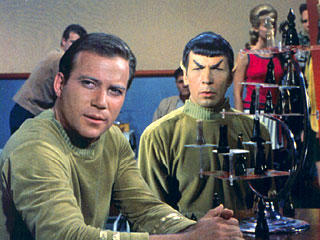 that he considered Star Trek IV a bit of lite fluff (which it is, but Shatner was much more dis- missive). But then it is clear from the interview that he hadn't yet made peace with his Kirk-self. All in all, the interview confirmed my opinion that Nimoy understands Shatner a great deal better than, for instance, Takei (who is one bitter guy if you've read his Star Trek autobiography).
Nimoy was Mr. Gregarious. Actually, whenever I've seen interviews with Nimoy, he is Mr. Gregarious. That whole cool, detached Spock thing is a bit of a front. His interview was much lengthier than the others. He got a little tired of it by the end. (How many times can you ask, "So will the fans like the movie?" in different ways? Shatner got so sick of it, he was practically curt.) The most cool thing about Nimoy is that he is a true gentleman; he has never descended, like some of the Star Trek gang, to rudeness towards the fans or to the other actors. He has tut-tutted the studio a bit, but as far as I can tell that's par for the course with studios.
Now Nimoy, like Shatner, has worried about his acting career being co-opted by his character: that green, pointy-eared man from Vulcan. But by the time he directed Star Trek IV, he'd obviously made peace with it. He wrote the I Am Not Spock book in 1976, I am Spock in the mid-90s. At some point, he realized, okay, this is my career, and hey, the Vulcan isn't a bad guy to be.
But Shatner's interview revealed a deeply unhappy man, who didn't want to live this same role over and over and over. At one point the interviewer said, "You come across as an ensemble cast." "Thank you," Shatner said, "because, of course, we aren't really. An ensemble cast is like the National Theatre in London where the cast lives and works together on pieces on a continual basis. We just come together every two to three years." In his rather nasty book, Takei accuses Shatner of being pompous and vain, etc. etc. because he won't show up to every single Star Trekky thingy with everybody else. My initial thought was, "Hey, the Vulcan likes him. Shut up, Sulu." My second thought, on seeing this interview, is that Shatner is far more reserved and far more reluctant to "be" Kirk than he has been painted.
I think, though, that Shatner has made peace with Kirk. He wrote a book about Star Trek conventions in 1999. He'd been very contemptuous of Star Trek conventions for a long time, but he finally decided to take another look (he was probably offered a contract to write a Star Trek memoir by a publisher). So he dressed up (disguised, which should tell you something) and went around convention halls and talked to people. The book is very upbeat. Since he has gone on to author some Star Trek novels, I'd say his anti-Trek feelings have been replaced by, well, acceptance at least.
The last interview was DeForest Kelley, who is a total kick. The interview reminded me of Jonathan Frakes (ST:NG's Riker) who pretty much declared, "Hey, this is as good as I am. I'm lucky to have this career," and married a model and started directing TV shows. Kelley comes off exactly the same way. He is a Hollywood careerist. That is, he works for Hollywood: heavies, background, whatever. There's no angst. I doubt he even cares if he can act. It's a job. This job turned out better than most. Well, what do you know!?
So that's the interviews. As for the movie, the text commentary is great although the fact that it is text is a bit annoying. I'd rather the commentators had spoken. But the commentary was the kind of thing I approve of: info, facts, tid-bits, bloppers, a little humor. None of that rather pointless "Uh, look Bob, do you remember that part?" "Oh, sure, Gary, yeah, yeah, I do."
Anyway I came to some conclusions:
First, William Shatner is a lot smarter and a good deal more reserved than his persona. I always pictured William Shatner as being rather like Tim Allen's character is Galaxy Quest (excellent movie by the way): so invested in his persona that it's hard to tell the difference between the character and the actor. Not so, and my opinion of Shatner's acting ability went up. His depiction of the bumptious, over-confident Kirk is deliberate, not accidental.
Shatner has also had classical training: Shakespeare, etc. I'll talk more about this later, but it was clear from the interview
 that he considered Star Trek IV a bit of lite fluff (which it is, but Shatner was much more dis- missive). But then it is clear from the interview that he hadn't yet made peace with his Kirk-self. All in all, the interview confirmed my opinion that Nimoy understands Shatner a great deal better than, for instance, Takei (who is one bitter guy if you've read his Star Trek autobiography).
Nimoy was Mr. Gregarious. Actually, whenever I've seen interviews with Nimoy, he is Mr. Gregarious. That whole cool, detached Spock thing is a bit of a front. His interview was much lengthier than the others. He got a little tired of it by the end. (How many times can you ask, "So will the fans like the movie?" in different ways? Shatner got so sick of it, he was practically curt.) The most cool thing about Nimoy is that he is a true gentleman; he has never descended, like some of the Star Trek gang, to rudeness towards the fans or to the other actors. He has tut-tutted the studio a bit, but as far as I can tell that's par for the course with studios.
Now Nimoy, like Shatner, has worried about his acting career being co-opted by his character: that green, pointy-eared man from Vulcan. But by the time he directed Star Trek IV, he'd obviously made peace with it. He wrote the I Am Not Spock book in 1976, I am Spock in the mid-90s. At some point, he realized, okay, this is my career, and hey, the Vulcan isn't a bad guy to be.
But Shatner's interview revealed a deeply unhappy man, who didn't want to live this same role over and over and over. At one point the interviewer said, "You come across as an ensemble cast." "Thank you," Shatner said, "because, of course, we aren't really. An ensemble cast is like the National Theatre in London where the cast lives and works together on pieces on a continual basis. We just come together every two to three years." In his rather nasty book, Takei accuses Shatner of being pompous and vain, etc. etc. because he won't show up to every single Star Trekky thingy with everybody else. My initial thought was, "Hey, the Vulcan likes him. Shut up, Sulu." My second thought, on seeing this interview, is that Shatner is far more reserved and far more reluctant to "be" Kirk than he has been painted.
I think, though, that Shatner has made peace with Kirk. He wrote a book about Star Trek conventions in 1999. He'd been very contemptuous of Star Trek conventions for a long time, but he finally decided to take another look (he was probably offered a contract to write a Star Trek memoir by a publisher). So he dressed up (disguised, which should tell you something) and went around convention halls and talked to people. The book is very upbeat. Since he has gone on to author some Star Trek novels, I'd say his anti-Trek feelings have been replaced by, well, acceptance at least.
The last interview was DeForest Kelley, who is a total kick. The interview reminded
 me of Jonathan Frakes (ST:NG's Riker) who pretty much declared, "Hey, this is as good as I am. I'm lucky to have this career," and married a model and started directing TV shows. Kelley comes off exactly the same way. He is a Hollywood careerist. That is, he works for Hollywood: heavies, background, whatever. There's no angst. I doubt he even cares if he can act. It's a job. This job turned out better than most. Well, what do you know!?
So that's the interviews. As for the movie, the text commentary is great although the fact that it is text is a bit annoying. I'd rather the commentators had spoken. But the commentary was the kind of thing I approve of: info, facts, tid-bits, bloppers, a little humor. None of that rather pointless "Uh, look Bob, do you remember that part?" "Oh, sure, Gary, yeah, yeah, I do."
Subscribe to:
Posts (Atom)