Read all about a damsel under interrogation on my novel page!
 |
| Dulcibel : A Tale of Old Salem, by Henry Peterson |
|
| Dulcibel : A Tale of Old Salem, by Henry Peterson |
 |
| Tabitha Ann Holton |
 |
| Old Police Station (Built 1879) |
| Alexander P. Kapp |
 |
| E.P. Samokish-Sudkovskaya Girl's Flight from Cow |
 |
| Hugh Welsh Diamond Melancholia Passing into Mania |
 |
| Julie Manet with Cat by Renoir from Wikimedia |
 |
| Prospective Cover |
In the aftermath of a spell-gone-bad, Aubrey discovers herself in perilous surroundings troubled by inexplicable scars and grisly memories. Initially at the mercy of deceitful fraudsters, she must outwit politicians, police detectives, and aristocrats to escape danger for safety. But is safety her true desire? As the agendas mount, Aubrey must literally as well as figuratively transform--or die.Chapter 1 will be posted August 16, 2013 on my Novel blog (linked to Votaries of Horror).
 |
| A possible Kellynch Hall from JASA. |
Captain Wentworth eyed [Will and Penelope] as they entered [the drawing room of their house]. Anne curtsied; Penelope responded quickly. Will returned Captain Wentworth’s curt bow, then stood behind Penelope’s chair. His stance mirrored Captain Wentworth’s. His use of mimicry, Penelope had learned in the last three years, was a protection against outsiders. She was an insider.
“You received my letter,” Captain Wentworth said to Will.
“You wish to discuss breaking the entail to the Kellynch Hall property.”
“Sir Walter’s health is failing. He has moved permanently to Bath. He is willing to break the entail for his daughter’s sake.”
Penelope scarcely believed it—the man’s self-love was so bound up in his ancestry—but then she realized that his self-love had always been as much for the form as for the substance. All said and done, Kellynch Hall was a means to an end.
Besides, attempting to break the entail would spite Will: Better his daughter in Kellynch Hall than the despised cousin.
“Are you committed to inheriting Kellynch Hall?” Captain Wentworth asked Will.
“It’s a pleasant area,” Will said.
“You don’t strike me as a countryman,” Captain Wentworth said.
No. Will was no countryman. After all, Penelope remembered, Captain Wentworth manages men on his ship; he isn’t lacking in perception.
Captain Wentworth continued: “Are you sure you would be accepted in Kellynch?”
His eyes didn’t flicker towards Penelope, but Will said sharply, “I believe the populace would be well-satisfied with the Hall’s lord and lady.”
Across from Penelope, Anne tilted her head. For the first time in their acquaintance, she looked at Penelope with real interest. Her eyes drifted to Will who slouched, half-sitting, on the arm of Penelope’s chair. So, her gaze seemed to say, you are not just opportunists.
Penelope said smoothly, “Town life certainly has more to offer.”
“We are country-folk,” Captain Wentworth said and settled into one of the armchairs. Apparently, he had decided that Penelope and Will were sensible people who would listen to reason. “Once I leave the navy, my wife and I would prefer a country residence. Kellynch Hall would be very much to our taste. We want to acquire it.”
Penelope silently applauded Captain Wentworth. Any other husband of a baronet’s daughter would have kept up the pretense of a friendly, non-financial visit for hours. The horror of appearing vulgar!
Captain Wentworth continued, “Since the entail has to be renewed in your lifetime, Mr. Elliot, this is a chance to review your options. And since renewal may not be possible—”
Because Will and Penelope currently had no son, and Jennie [Will and Penelope's daughter] could not inherit. The Wentworths weren’t fools; they were going to press their advantage now, even if it meant dancing around their dislike of Will and Penelope. At least, Captain Wentworth disliked them. Anne seemed more curious than disgusted.
“My husband will not give up the title,” Penelope said.
She felt Will’s bright gaze on her, but she didn’t look away from Captain Wentworth’s speculative stare.
“Do you think of yourself as a baronet?” Captain Wentworth said to Will in a tone that suggested he didn’t think Will merited any title, including “captain.”
“Of course Sir Walter’s cousin should inherit the title,” Anne said quickly. “You are my father’s heir, Mr. Elliot.”
To give the Wentworths credit, Penelope doubted they cared about the title. In the City, however, a title could open doors for Will. And Penelope saw no reason why he should give up what was rightfully his.
Will said, “Penelope’s father, Mr. Shepherd, should be kept on as manager.”
“He’s too good to let go,” Captain Wentworth said. His tone added: Despite his daughter’s scandalous behavior.
Penelope resisted rolling her eyes. She knew how to play this game. Everyone brought deficiencies to the table and every deficiency had a cost. My scandalous behavior versus Anne’s non-male gender. Anne’s lack of maleness cost her more than scandalous behavior ever cost Penelope; Penelope didn’t see why she should allow anyone to forget that.
She said, “Since only my husband can break this entail, we expect to be compensated. The property is nearly disencumbered of debt. It will make a tidy profit in a few years’ time.”
Anne leaned forward, her eyes filled with the quiet speculation that marked this middle Elliot daughter. Anne knew that Penelope had no real tie to or love for Kellynch; Anne would remember how quickly Penelope left it behind the first time.
For Will, Penelope might endure it. But Will had no interest in playing squire. However much he liked the idea of a country estate, he’d never bother with the day-to-day. He would hire a qualified agent (who only skimmed slightly off the accounts) and move on to another endeavor.
Penelope could direct his energies better elsewhere. The Wentworths would get all the unpleasant noblesse oblige of being estate landlords while Will and Penelope stayed in London and watched its neighborhoods grow. The Wentworths would thrive, Penelope assumed. Kellynch Hall was their type of place.
She thought fiercely: I only want Will to thrive.
She turned back to Anne. Anne, still leaning forward, gave her a seraphic smile, and Penelope realized, Sir Walter’s unappreciated daughter is getting everything she wanted. Well, well, Miss Anne Elliot. Good for you.
Captain Wentworth said, “It is still encumbered, however. That should be a consideration.”
Will laughed. He tapped Penelope’s shoulder as he crossed to the decanter and poured himself a glass. He held out another to Captain Wentworth who took it after only a slight pause.
Détente.
 many of whom seemed to suffer from dark tangled locks and early deaths. I obtained the drawing of Keats (ill, near death) when I was on a study abroad program in London as an undergraduate. At the same time, I viewed (but was less impressed by) the overwrought statue of Shelley by Edward Onslow Ford (1892) .
  Austen falls between the Classicist era and the Romantic Movement. Consequently, alongside her romantic impulses she provides a heavy dose of pragmatism. Many modern romances--set in the Regency era--have adopted this same approach. Although Charlotte Bronte, a devotee of a Romantic era (and a favorite author of mine), poured scorn on Austen, modern writers have recognized Austen's pragmatism as a perceptive and forward-looking acknowledgment of how difficult women's choices could be--as Mrs. Clay fully knows:
[Penelope Clay and Will Elliot meet at Bath's Abbey.]
They sat together and contemplated the warm light on the near-white stone.
“You know I don’t want you to marry Sir Walter,” Will said finally.
“For fear I will give him a son.”
Will didn’t reply immediately. She kept her eyes on the pew back before her.
He said, “I would hate to lose the baronetcy at the eleventh hour.”
“You never wanted it before.”
“People change—well, not really. But our desires do. We become more ourselves. Or less. Or something. More of what we’ve been heading towards.”
“You’ve been heading towards a baronetcy?”
“Towards stability—money, land.” He paused. “A helpmate.”
“Helpmate?”
“I need company. I’m too old for frivolity. Too young for dourness.”
She supposed his late wife had been frivolous. She never thought of Anne as dour but likely Will was referring to Elizabeth.
She questioned the unspoken elimination: “What about Anne?”
“She discovered that I married for money.”
“Everyone knows that you married for money.”
“But I kept it. That’s the real sin, you know. Sir Walter can be pompous and proud and his insolvency embarrasses Anne, but at least he isn’t stingy. That would truly mortify her. Me, I kept my wife’s money, invested it—for her sake as well as my own—and held onto it when she died. I didn’t fritter it away on her friends or invest in useless legal actions. It’s positively . . . bourgeois.”
“It’s intelligent,” Penelope said.
“See, I knew you understood me. I think we could get on well together. I would give you a home.”
She started. She’d anticipated seduction, not anything as long-range as the suggestion that she become Will’s mistress.
“And I’d support your sons.”
She nodded. A mistress was not as secure a position as a wife, but a clever mistress bartered for certain benefits. Though Penelope wasn’t much of a mother, she was enough of one to get her sons situated where they could make connections and obtain good employment.
She sighed, aware that Will watched her.
She said, “How long would our affair last?”
“I don’t know. I never think that far ahead. Long enough for me to enjoy you.”
Penelope flushed and stood. “I should get back.”
He also rose, his hand at her elbow.
“You’re supposed to be on the road to Thornberry,” she said with only slight asperity.
“I’ll walk you out to Stall Street.”
As they left the Abbey, Penelope resisted the impulse to lean into the hand that still hovered at her elbow. Will might not be the best solution to her future, but he was a kind of solution, and she wanted to be done with scheming.
She said abruptly, “And if I took your offer?”
He halted, turned her towards him by the shoulders. “You’d come with me. Right now. All the way to London.”
“We would miss the card party tomorrow.”
“We will both become personae non grata with the Elliots . . . should you accept,” Will said. “Personally, I can bear to give up their company. Can you?”
She was beginning to believe nothing would please her more.
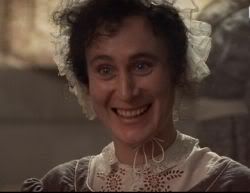 | |
| 1995 Mrs. Smith--she does an excellent job | |
| conveying Mrs. Smith's pleasure in life. |
 |
| West Indies Map |
Gary (the literary analyst) rolled his eyes. “And, of course, romance novels always have perfect weddings.”
“Of course.”
“This whole novel [Pamela] is nothing but trite and shallow pandering,” Gary declaimed. “What about death, disease, poverty, slavery, racism—all the terrible issues of the eighteenth century? Hmm? I mean women couldn’t even vote! But no, we’re fixated on watching an inconsequential couple tie the knot.”
The judge glanced towards the characters’ table. Mr. B was still smiling faintly. He hadn’t flinched at being called “inconsequential.” Presumably, people of the eighteenth century were less obsessed with getting their “day in court” than people of the twenty-first.
The judge reminded himself not to chuckle at his own pun.
“People hid their heads in the sand,” Gary was still declaiming. “Just like they do today.”
The romance writer reviewer, Deborah, said, “That sounds like the end of a lecture,” and Gary reddened.
She was probably right—the man certainly loved to carp about stuff—but the judge didn’t want audience members giving the Committee for Literary Fairness any (more) reason to complain.
He said pacifically, “Different novels cover different topics.”
Leslie Quinn, the writer of popular non-fiction, agreed, “People in the eighteenth century still had to work, love, have children, get along. Those topics never go away.”
Dr. Matchel (another literary analyst) said, “But romance novels don’t deal with real domestic problems. They end with the wedding, giving readers the false impression that married life will be eternally happy. Escapist literature!”
"This novel doesn't end with the wedding," Mr. B's attorney pointed out, muttering, “What’s wrong with escapism?”
Deborah added, “Dark and depressing isn’t automatically profound.”
| Not the cover from Austen's | |
| day, of course, but effectively | |
| captures the essence of the book. |
 | ||
| Elizabeth Canning on trial | ||
| for perjury. |
Will Elliot . . . dropped by Camden Place with [Penelope's] book. She received him in the sitting room; no one else was home, and the servants were typically unavailable. As soon as he entered, Will lounged into a chair and tossed over The Memoirs of Miss Sidney Bidulph.
“You have a taste for troubled heroines.”
“She reminds readers that marriage is a troubled state.”
“Isn’t she terribly selfless and forbearing? Are non-fictional women ever that self-effacing?”
“Oh, yes,” Penelope said and told him what [she had learned] about Anne and Captain Wentworth['s history].
“I thought there was a history there,” he said. “Pity for Miss Anne she didn’t accept. The man is worth thousands. But then, of course, she would feel a duty to her family, her name, etcetera.”
“In this case, it was more a duty to her friend. Lady Russell was the deciding factor.”
“She probably stands in loco parentis to Anne. Young girls are supposed to avoid calamity by listening to their mothers.”
Penelope hadn’t considered that aspect of the relationship: she so rarely felt like a mother herself—or like her mother’s child. She nodded dubiously, trying to comprehend a state of affairs where she would sacrifice her own objectives at someone’s suggestion, no matter how well-meant that suggestion.
“Although I’m surprised Lady Russell objected,” Will said. “The man isn’t that far down the social ladder.”
“Lady Russell thinks Anne deserves a duke or a prince. Someone of tremendous worth anyway.”
“Like me?!” Will exclaimed in mock astonishment.
“You have the family name.”
“Of no remarkable history.” Will tipped back in his chair.
They sat in companionable contemplation of the unexceptional Elliot name.
“You are currently slated to inherit Kellynch Hall,” Penelope pointed out.
“And naturally Lady Russell would like to see her protégé ensconced there, emulating Lady Bountiful to the obsequious villagers.”
“Anne would probably do it very well.” Penelope gave him a curious sideways glance. “You don’t have a high opinion of this baronetcy that you claim to want.”
“One should never sneer at the prospect of obsequious villagers or the possibility of more money. Besides, I need a change in lifestyle.”
“Country-life would bore you.”
“Is that why you’re threatening to give Sir Walter an heir—to keep my life interesting?”
Penelope just smiled. Will had a far more optimistic opinion of Sir Walter’s prowess than she. Penelope had no desire to produce more children in any case. She would rather Sir Walter funded her living sons’ educations than try to create fantastical ones.
She could assure Will of her disinterest in a legacy. She could tell him that she only wanted to be the wife of a baronet, not the mother of one. But he would not believe her. He would point out that Sir Walter might insist on his conjugal rights and Penelope had proven she could produce male children.
He said, “I suppose I’ll have to pursue Miss Anne more vigorously.”
“I don’t think you could achieve her now.”
“Oh?” Will’s chair tipped forward, so his laughing eyes met hers. “Are you so sure of Captain Wentworth’s ascendancy?”
“He’s a lover from her youth.”
“A spring-time lover. By autumn, young plants have grown and died. Or turned to mulch. New beds must be made.”
Penelope shook her head. “She would have married already if she didn’t still love him. Anne is the marrying kind. She is competent and sympathetic and spends her time servicing her family’s needs.”
“Not like you.”
“No.”
Penelope’s parents would look after her sons no matter what happened to her. No one would look out for Penelope but Penelope.
Will was leaning forward now, eyeing her over clasped hands.
“I do need to consider my future,” he said. “I should pursue this paragon for myself.”
“You’ll have a chance at the concert tonight,” Penelope said and stood. “Thank you for delivering my book.”
Upstairs in her tiny room, she tried to forget Will’s speculative gaze. She needed to focus on Sir Walter. Will Elliot had proved an amusing distraction, but she had to stop eliciting his attention, provoking him to spurts of laughter, trying to impress him with her insights.
I’m as bad as Sir Walter, enamored by a charming man. Only Anne seemed to have guessed Will’s true nature and held herself aloof. Let him try to win her. Let him marry her. It won’t be love. Penelope didn’t think Will Elliot could genuinely love anyone. She was not such a fool to test the possibility.
 |
| Elvi Hale as Anne of Cleves shrewdly politicking |
| with Keith Michell's Henry VIII to avoid |
| becoming one of his causalities. |
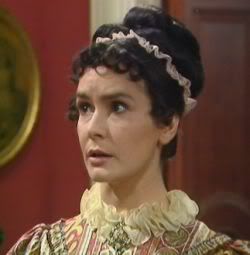 |
| 1971 Elizabeth--I consider her the closest to the |
| original. 1995 Elizabeth is too bratty (Elizabeth IS |
| a lady). 2007 Elizabeth and Sir Walter are too |
| calculating. Elizabeth is clueless, not malicious. |
“William Elliot isn’t as handsome as I’d like,” Elizabeth said complacently. “But he is respectable.”
She and Penelope sat in Elizabeth’s bedroom while Elizabeth tested different brooches against her skin.
“I suppose he will wish to live at Kellynch Hall though I must say I am finding Bath more and more to my taste.”
Mr. Elliot has absolutely no interest in marrying you, Penelope did not say.
Penelope guessed that William Elliot had reinitiated contact with his relations to ensure his inheritance. He’d been clever enough to worm back into their good graces. He might try to use that cleverness to prevent Penelope from marrying Sir Walter.
He’s not as clever as me.
Penelope moved to the window and grinned down into the street. She hadn’t been tested like this since her landlord tried to make love to her. She’d gotten his wife to take her part against him—after she walked away with a new pair of gloves, money to pay the coal bill, and her virtue intact.
Far below on the pavement, Mr. Elliot’s compact form neared the front stoop.
“Mr. Elliot is gracing Camden Place with another appearance,” Penelope said mildly.
Elizabeth put away her brooches, flicked dust off her sandals and tsked over how the servants dusted, all before descending to the drawing room. Following, Penelope shook her head. Elizabeth did not exhibit the characteristics of a woman anxious over a potential mate but rather those of a woman contemplating what piece of furniture to add to her household.
Poor Mr. Elliot.In Chapter 10--which includes the well-known scenes in Molland's--Mr. Elliot returns to Elizabeth's side after asking Lady Dalrymple to transport the Elliot coterie back to Camden Place. He is aware that Penelope Clay is trying to undermine his pursuit of Anne (in retaliation for he undermining her pursuit of Sir Walter) and plans to use the carriage ride to even the score. What is notable, in both Persuadable and the original text, is Elizabeth's complete indifference to what a walk with Mr. Elliot means (emphasized below):
Lady Dalrymple was a much more rational person than Sir Walter’s fawning might lead one to believe. She had an infinite store of small-talk and limited interests, but she was not callous or indifferent to a minor predicament. Naturally, she could convey two ladies to Camden Place.
Will didn’t press for the inclusion of a third. His commission had become an opportunity.
He returned to Molland’s and sadly informed the ladies that there was only room for two since Miss Carteret accompanied her mother.
“I will walk a lady home with pleasure,” Will said.
Elizabeth looked unimpressed. “I have a message for Lady Dalrymple from my father,” she said.
Her expectation that Will would court her apparently didn’t extend to actually wanting to spend time with him.
Anne said, “I could use a walk.”
From her quick but level response, Will guessed that Anne was motivated less by the possibility of Will’s company and more by a desire to avoid Lady Dalrymple’s conversation. Whatever her motives, her agreement was a gain for him.
Until, “I’m sure you would prefer to join your sister, Miss Anne,” Penelope said kindly. “I can walk with Mr. Elliot. You will avoid getting soaked and endangering your health.”
“The rain is a trifle,” Anne said, looking somewhat surprised; she had likely expected Penelope to leap at a chance to ingratiate herself with Lady Dalrymple.
“But there are puddles,” Penelope said. “My boots are much thicker than yours, you know.”
“You have a little cold,” Elizabeth said to Penelope. “Anne should go with Mr. Elliot. She will be fine.”
Penelope turned to Will, lids drooping. “Perhaps Mr. Elliot should choose.”
He wanted to laugh. He also wanted to suggest that Penelope’s cold was hardly a threat, her boots were impressively thick, and offer to take her home. An entire walk exchanging observations with a clever woman who knew him was a rare pleasure.
But the object here was to win Anne’s company. He chose her.
Penelope’s mouth twisted into a wry smile. She said, her voice like velvet, “Before you and Miss Anne embark, Mr. Elliot, perhaps you would fetch a parcel for me from the bookstall on Union Street?”
He bowed quickly and headed for the door before he broke into convulsing guffaws.
I won that skirmish, but Penelope Clay still holds the field.
 |
| Another Gainsborough: Viscountess Tracy |
Mrs. Allen was one of that numerous class of females, whose society can raise no other emotion than surprise at there being any men in the world who could like them well enough to marry them. She had neither beauty, genius, accomplishment, nor manner. The air of a gentlewoman, a great deal of quiet, inactive good temper, and a trifling turn of mind were all that could account for her being the choice of a sensible, intelligent man like Mr. Allen.Nearly 14 years later, Austen is far less critical of the Mrs. Allens of the world. After all, one learns as one ages that pointless conversations about supposedly tedious subjects do far more to keep the social exchanges of everyday life oiled and functioning than PROFOUND, INSIGHTFUL, ANGST-CAUSING speeches.
[F]or the Dalrymples (in Anne's opinion, most unfortunately) were cousins of the Elliots; and the agony was how to introduce themselves properly . . . Anne was ashamed. Had Lady Dalrymple and her daughter even been very agreeable, she would still have been ashamed of the agitation they created, but they were nothing. There was no superiority of manner, accomplishment, or understanding. Lady Dalrymple had acquired the name of "a charming woman," because she had a smile and a civil answer for everybody. Miss Carteret, with still less to say, was so plain and so awkward, that she would never have been tolerated in Camden Place but for her birth.This is Anne's voice, not Austen's. Austen's castigation of Mrs. Allen in Northanger Abbey presents Mrs. Allen's personality as an absolute. But in Persuasion, Austen is far more willing to step back and let her characters judge others fairly or unfairly. As the above passage indicates, Anne hasn't fallen that far from her father's tree when it comes to casting judgment.
Mother and daughter were far less ogreish than Penelope had anticipated. Lady Dalrymple was a plump, placid creature. Miss Carteret was rather odd though not on purpose; she simply lacked basic social instincts. She laughed when others were serious, carried on monologues that others, including her own mother, ignored.
Penelope had no trouble impressing the pair; all she had to do was look deferential and listen to their vague comments on Bath, the weather, and—Miss Carteret’s preference—domesticated felines.
Sir Walter was so encouraged by the visit that he remained in a good humor for nearly three days, making only four or five disparaging remarks about Penelope’s complexion. He even escorted Penelope around the Pump Room himself one morning when Elizabeth was otherwise engaged. Penelope began to wonder if she should start dropping stronger hints about the comforts of the marriage state. In this mood, Sir Walter was easy to manage.
Anne was to blame for destroying Sir Walter’s bonhomie.
“I received a note from charming Lady Dalrymple,” Sir Walter exclaimed one morning. “She is feeling poorly. We must call on Laura Place and raise her spirits.”
But Anne didn’t want to join the Dalrymple Entertainment Committee. “I have already made plans to visit my friend, Mrs. Smith," she explained.
Sir Walter sulked, stamping about the drawing room, and waving his arms. “Who was Mrs. Smith’s husband? One of five thousand Mr. Smiths? What is her attraction? That she is old and sickly? She must be near forty.”
“Thirty-one,” Anne said patiently. “I cannot put off my engagement with her, sir.”
“Lady Russell surely doesn’t support this association,” Elizabeth said.
“She does. She thinks it is most proper that I maintain it.”
Sir Walter waved off Lady Russell’s thoughts on propriety. “People will know that Anne Elliot visits a mere Mrs. Smith, who has only thirty to forty pounds per annum.”
Penelope left the room. She stood in the hall, perfunctorily brushing down her dress. She knew that Sir Walter compartmentalized his attitudes. He would see no connection between Anne’s widowed friend of no name and no income with Mrs. Clay, his daughter’s companion who resided under his roof and within his good opinion. But Mrs. Clay saw it. If Anne Elliot had a crueler streak, she would have reminded him.
Penelope realized that she was trembling. Every day, her anger at this family became harder to fight, took longer to abate.
Once I am married, things will change. Once I am married, life will be so much better.
 |
| Gainsborough: Possible Anne! |
 |
| Sargent |
 |
| Portrait by Hoare |

[Will Elliot] entered Camden Place’s drawing room to discover an extra occupant: Cousin Anne had arrived that afternoon.
Will let his surprise show. He’d seen Anne Elliot in Lyme and admired her looks. He’d just never imagined that the woman he’d seen there could be his cousin. Her family spoke of Miss Anne so slightingly, he’d pictured an unimpressive, sparrow-like, featureless creature.
Anne Elliot was a truly beautiful woman with elegant bones, straight brows, and clear eyes. Elizabeth paled beside her.
She was also truly shy—none of Mrs. Clay’s coy pretense—and reserved in a way Elizabeth could never master. Such shyness was bred into the bones; Anne had the classic repose of a Gainsborough portrait.
Will recognized Mrs. Clay as pure William Hoare—those knowledgeable gleaming eyes.
Miss Anne saw Will’s surprise; since he wouldn’t gain anything by dissembling, he exclaimed, “But we saw each other at Lyme! We both stayed at the Three Cups Inn.”
“Yes,” she said and blushed faintly.
“Did you enjoy your time there? You were part of a large party—”
“Yes.” The blush increased, and Will rummaged through his memory for which male member of the party might have caused that blush. “I was with my sister Mary and her husband and her husband’s sisters.”
“The Musgroves. Of course!”
“Yes. And Captain Wentworth—” a quick glance towards her father—“whose sister and brother-in-law are staying at Kellynch Hall.”
“Admiral Croft is my tenant,” Sir Walter said sonorously.
“Plus some of the captain’s friends. We were a merry group.”
“And I spent my evenings alone! If only I had introduced myself! I am too careful when traveling. I learned as a youth not to be too curious or too forward, even with my own relations.” An apologetic glance at Sir Walter. “The follies of youth!”
Miss Anne looked doubtful at Will’s metaphorical breast-beating but said, “I will happily give you my opinion of the area.”
“Were you there long?”
“Our visit was ending when one of the Musgroves—Louisa Musgrove—had a bad fall.”
“Oh, yes,” Elizabeth said quickly, inserting herself into the conversation. “How is dear Louisa?”
“Much recovered.”
“Is she still at Lyme?” Will asked.
“She’ll return soon to the Musgrove’s home in Uppercross. She may be weak for several more months.”
“How dispiriting,” Sir Walter said in a tone that suggested Louisa’s condition (and momentary celebrity) was as inconvenient as it was depressing.
“Perhaps she should try the Bath waters,” Penelope Clay said, and Will shot her a look. Her tone was nearly acerbic, but Sir Walter only nodded sagely.
Turning back to Miss Anne, Will saw she had noticed her father’s acquiescence to Mrs. Clay’s participation. Miss Anne did not look pleased. No wonder the widow was so careful around this particular Elliot daughter.
He caught Penelope Clay in the hall as he prepared to leave. “Now that Elizabeth has her sister’s companionship, I suppose you’ll be leaving the family and returning home.”
“I will naturally suggest it,” she said demurely, and Will had to chuckle. Sir Walter and Elizabeth would beg her to stay. Miss Anne was clearly not deprecating enough to fulfill Elizabeth and Sir Walter’s needs. Everyone preferred a sympathetic and friendly dog on the hearth to an aloof and disinterested cat.
Until they discovered the dog was actually a hungry wolf.
 |
| 1995 Sir Walter |
“William Elliot isn’t as handsome as I’d like,” Elizabeth said complacently. “But he is respectable.”
She and Penelope sat in Elizabeth’s bedroom while Elizabeth tested different brooches against her skin.
William Elliot was much less than respectable and much more than handsome. He had an abundance of fine straight hair that only just managed to look combed, light-colored eyes under slightly slanting brows, a straight nose, and an excessively sardonic mouth in a pugnacious jaw.
But Sir Walter and Elizabeth obviously only saw in him what they had decided to see, so Penelope didn’t correct Elizabeth’s muted praise. She would be condemned for impertinence (to the heir!) and then ignored.
[Mr. Elliot arrived, and they went downstairs.] Penelope and Elizabeth entered the drawing room. Mr. Elliot stood by the mantel with Sir Walter. He came forward, bowed and accepted Elizabeth’s elegantly extended hand. Penelope didn’t try to mimic her. She was not particularly graceful when it came to curtsies and such. She suspected that her discomfort with forms of deference bled through. Better to hover obsequiously and smile encouragement at Elizabeth.
“Mr. Elliot has been taking the Bath waters,” Sir Walter told them. “Look how it has refreshed his appearance.”
Mr. Elliot looked refreshed and slightly amused.
“The water has also benefited Mrs. Clay,” Sir Walter continued. “Along with Gowland’s Lotion, it has eliminated most of her freckles.”
A shock of sudden fury tensed Penelope’s shoulders. She scolded herself an instant later: Sir Walter always commented on her looks.
I ought to be used to it by now.
She was succumbing to the constant exposure. Back home, Penelope had prepared herself mentally for visits to Kellynch Hall. Here, petty comments about her skin, teeth, and posture were unending; she never knew when a casual conversation would be interrupted with a critical remark.
Penelope had never understood why people like Sir Walter felt it necessary to point out the obvious about others’ appearance. She knew how she looked. It wasn’t as if his comments surprised her. And it wasn’t as if his opinion mattered: Penelope had poured Gowland’s Lotion into the rain gutter the afternoon Sir Walter gave it to her.
Mr. Elliot was watching her. He knew she’d tensed. She took a deep breath and cocked her head. Smiling, she said, “The water has also eased Sir Walter’s aches and pains.”
Take that, old man.
Mr. Elliot’s eyes crinkled; there were many laugh lines at their corners. Penelope lowered her own gaze.
“It’s a bright, sunny day,” Mr. Elliot suddenly cried, “despite the chill. We should walk along the Royal Crescent. Ladies, fetch your wraps.”
Penelope took her time collecting her wrap and herself, but she still returned to the drawing room before Elizabeth. Mr. Elliot was alone, flicking through a magazine. Sir Walter had rushed off to check his appearance before venturing into public.
Mr. Elliot said, his voice full of mischief, “The walk will freshen your cheeks, Mrs. Clay.”
“It won’t shrink your jaw,” she said sweetly.
He laughed. “Is that Sir Walter’s main criticism of my appearance? The man is shallower than standing water.”
“Suppose I tell him you said so?”
“Suppose I tell him you are trying to maneuver him into marriage?”
He appreciates how well I know my place.”
“He doesn’t notice your place’s shifting nature. I’ll have to stay close if I want to bring your place to his attention.”
“The family will encourage as much closeness as you can bear.”
Mr. Elliot followed Penelope’s gaze towards the ceiling and Elizabeth’s location. He grimaced, then, “There’s the unmarried sister, Anne.”
“She dislikes sycophants.”
“Really?” He lifted a brow at Penelope over his shoulder, and she couldn’t help but respond with a moue. He grinned.
“Sir Walter will be surprised if you pursue Anne,” Penelope continued. “He considers her looks to be much faded.”
“Some things matter more than looks,” Mr. Elliot said, lowering his voice: outside the drawing room, Elizabeth and Sir Walter were descending the stairs. Mr. Elliot headed towards them. As he passed Penelope, his shoulder brushed hers; he bent his head—
"Personally, I wouldn’t mind licking your freckles,” he said softly.
Well. If he planned to battle her that way she’d need a greater store of aplomb.
 |
| Steep stairs on the Cobb at Lyme. |
“I never put down the Elliot name!” Mr. Elliot exclaimed in answer to a querulous remark from Sir Walter. “I have ever boasted of being an Elliot.” (What he had said was, “Thank God I’m an Elliot with sense.” And he’d only mocked Sir Walter to his wife’s friends when his Kellynch cousins were mentioned—which was hardly at all.)
Mrs. Clay’s mouth twitched. Will put down his utensils and gazed at her, bringing the others’ attention to her side of the table.
She said, the twitch utterly wiped out, “Of course you did, Mr. Elliot, for who would not be proud of such a connection?!”
He nearly glared at her except Sir Walter had refocused on him, uttering harrumphs of approval.
Returning to the drawing room, Will said pointedly to Elizabeth, “Your sisters will keep you company this winter?”
“Anne is coming soon with Lady Russell. I don’t know if Mary will visit.” Mary was the youngest sister. “There’s been an accident with one of our in-laws.”
“Mary’s husband’s sister, Louisa, had a bad fall,” Mrs. Clay said softly. “She struck her head, and they are still unsure if she will regain her wits.”
“Yes,” Elizabeth said. “Anne wrote something about it. She was there when it happened.”
Will barely managed to restrain his surprise. His wife Sally had been aggravating in the extreme but when her best friend was killed by a racing carriage, Will had held her while she cried. He hadn’t been so awful a husband that he couldn’t sympathize with unexpected terror and pain.
Elizabeth behaved as though Anne had witnessed a minor brawl at a local fair.
For a moment, Will’s eyes met Mrs. Clay’s. A faint wryness touched the corners of her mouth, then she leaned forward solicitously to ask Sir Walter if he was comfortable.
Will broke in: “Where did this accident occur?”
“In Lyme.”
Will had passed through Lyme on his way from Sidmouth. A collection of pretty women and soldierly-looking men had stayed at Will’s inn. No doubt, the unmarried Elliot daughter had been among them.
I should have introduced myself. I might have met the other unmarried daughter—
Will shrugged mentally. Reintroducing himself to anyone in the family but Sir Walter would have gravely offended the man. He must tread carefully, for Mrs. Clay—patting a pillow for Sir Walter, assuring him that a man of his well-maintained posture deserved a bolster—was a more subtle threat than Will had initially anticipated.

 |
| The amazing Freeman and Cumberbatch: Watson & Holmes. |
Will Elliot was fully resolved to marry for rank this time around.
“Duchesses have just as many bills as shopkeepers,” Jeremy pointed out.
Colonel Jeremy Wallis was Will’s oldest friend, a stable point since grammar school, one of the few people Will entirely trusted.
“Besides, if you have a baronetcy, you can marry however you wish—high, low, or sideways.”
Will sat in the Wallis’ sitting room in Bath. He’d stopped to see Jeremy and his wife, Stella, on his way to London. He slouched in a large overstuffed chair, legs stretched across a square rug.
Stella Wallis said, “You might not get the baronetcy if Mrs. Clay has her way.”
Will raised one brow, then grinned at the sight of Stella perched on her husband’s knee; one of her hands caressed the sloping evidence of her pregnancy. She and Jeremy were a compatible couple: approachable, unpretentious, full of easy gossip and commonsense.
“Who’s Mrs. Clay?”
Jeremy grimaced. “Your Cousin Elizabeth’s companion. Miss Elizabeth and Sir Walter are in Bath, you know.”
Will raised both brows.
“Sir Walter would never marry a mere companion,” he said.
“Oh, she’s clever,” Stella said. “She’s already wriggled her way into Miss Elizabeth’s confidence. Nurse Roark says Miss Elizabeth tells Penelope Clay all her secrets.”
Nurse Roark went everywhere in Bath, nursing babies, infirm gentlemen, and sickly gentlewomen. If a rumor needed confirmation, Nurse Roark could do it.
Stella continued, “Roarky thinks Mrs. Clay should marry Sir Walter; she says all older gentlemen should marry again—”
“Their nurses presumably,” Jeremy said, cuddling her, and they all laughed.
Jeremy said more seriously, “Mrs. Clay was married before—and produced two sons which means she can produce them. And there goes your baronetcy.”
Will had always appreciated Jeremy’s grasp of basic issues, such as money and entailment.
“Of course, Sir Walter could try to break the entail,” Jeremy said now.
“He didn’t try to break it to clear his debts. His ego is bound up in the property. Besides, he can’t break it without contacting me, which he’ll never do. I think we’re—what’s the term?—estranged.”
“And he may believe he can still sire a son, pushing you aside.”
Will shoved out of the chair and strolled towards the sitting room’s window. It showed a long vista of walls and shops that ended with the commons that edged Bath. Colonel Wallis had lodgings in Marlborough Buildings.
Will said, “I suppose I should call on my relatives when I return here from London.”
“You could marry into the family,” Jeremy said. “Sir Walter has such a passion for family ties, he’d respect a son-in-law’s opinions.”
“I won’t marry the snob,” Will said, meaning Elizabeth. “There’s another unmarried sister. She’s reputed to have a sweet character.”
Jeremy said, “Or you could seduce Mrs. Clay,” which got them all laughing again.
 Back at the agency, it took Lee less than fifteen minutes to dismantle the hairdryers in Judy’s package and reorganize the components into a very real, very lethal gun.
